
When a brand searches for a seamless bra factory in China with private label capability, the real question is rarely “is seamless comfortable?” It is: can this factory build my product consistently, on time, and within budget, at 500 pieces and again at 5,000?
This guide answers that from the factory floor. It covers how private label seamless clothing is made, why custom MOQ is what it is, how logos behave on knitted fabric, and what to check before you sign with any supplier, including us.
Quick facts: YOU Seamless private label programs
| Item | Detail |
|---|---|
| Factory | Our own factory, 12,000 ㎡, 180+ staff, established 2014 |
| Annual capacity | 2.5 million pieces |
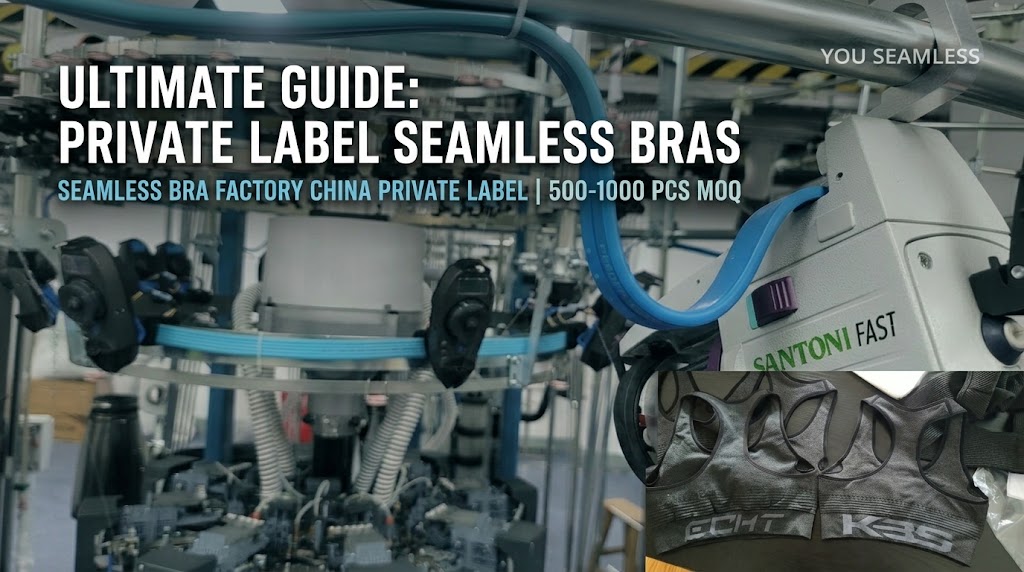
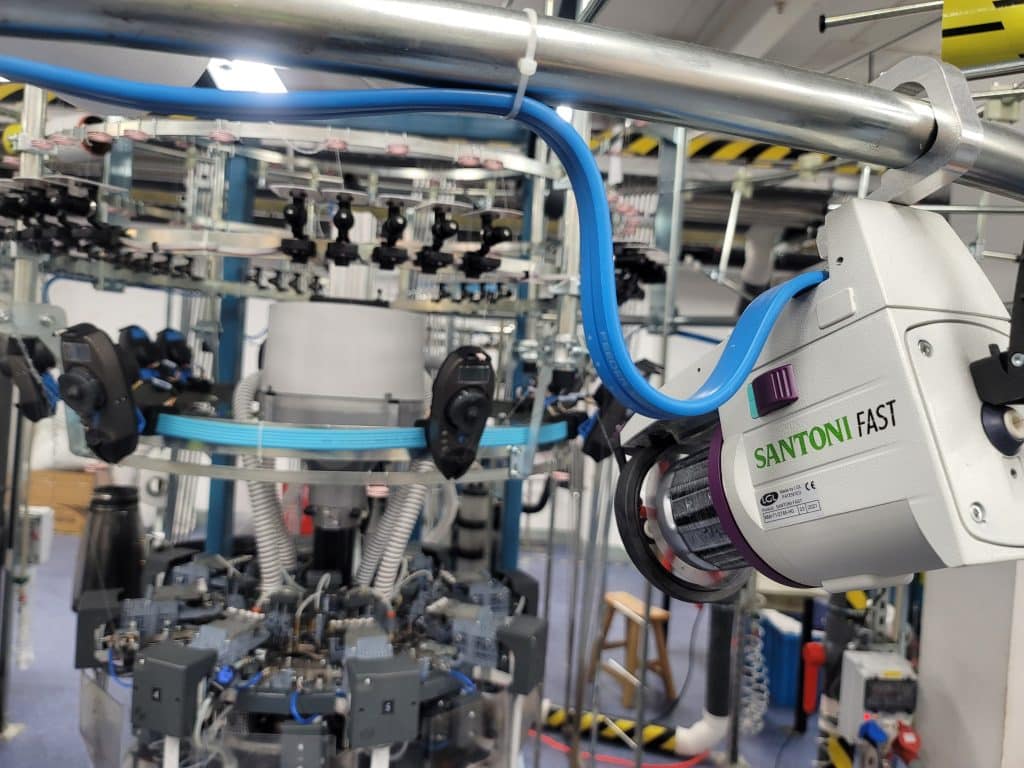
| Knitting equipment | Santoni SM8-TOP2V and TOP2 FAST, 28 gauge |
| Stitching | Flatlock (4-needle 6-thread) and Coverstitch (3-needle 5-thread) on Juki and Pegasus machines |
| Custom MOQ | 500–1,000 pcs per design (600 pcs can include 2 colors and 3 sizes) |
| Ready stock | From 1 piece, with logo, label and packaging options; 100,000+ pieces of finished goods and greige fabric in stock |
| Sampling | 2–3 days for stock samples; 8–15 days for custom development |
| Bulk lead time | 40–45 days after pre-production sample approval |
| Inspection | 5-stage 100% inspection, AQL 2.5 |
| Compliance | Amfori BSCI, GRS, OEKO-TEX® Standard 100 |
| Shipping | Specialized shipping lines to Europe, USA, Australia, UK, New Zealand, UAE & SA; DDP options available |
What Is Private Label Seamless Clothing?
Private label seamless clothing is activewear, bras, leggings and base layers knitted to your specification and sold under your brand name. These terms get mixed up often, and mixing them up leads to wrong quotes.
| Model | Who designs it | What you control | Typical fit |
|---|---|---|---|
| White label | Factory | Label and packaging only | Fast test of a market |
| ODM | Factory develops from its own library | Fabric, color, logo, packaging, small design changes | Brands without a technical team |
| OEM | You | Full pattern, knit structure, fabric, trims | Brands with a tech pack or reference sample |
| Private label | Umbrella term | Your brand owns the product line | Most B2B buyers |
For a seamless bra you can customize the logo, labels, packaging, fabric blend, color, size range, support structure (padding, bands, strap design) and knit zones. Not everything is free at every quantity.
Why Source Seamless Bras from a China Factory?
We would rather talk about certainty than lowest price. For seamless, the case for China rests on three things.
- Machine density and know-how. Circular seamless knitting needs programmers, mechanics and finishing teams who have run these machines for years. That ecosystem is concentrated in a few Chinese production clusters.
- Development speed. A knit program, a yarn change and a dye match can be sampled in 8–15 days at our factory. Shorter loops mean more design iterations before you commit to bulk.
- Export experience. Documentation, chemical compliance (OEKO-TEX® Standard 100), recycled-content claims (GRS) and delivery to your market are routine for an experienced exporter. We ship through specialized lines to Europe, the USA, Australia, the UK, New Zealand, the UAE & SA, and DDP (Delivered Duty Paid) options are available.
China is not automatically the right choice. A supplier without its own knitting machines is a trading layer, and that is where quality drift and missed dates come from. This is why equipment ownership is the first thing to check.
How Seamless Private Labeling Differs from Traditional Cut & Sew
In cut-and-sew, fabric is made first, then cut and stitched. Size is a pattern decision, and you can mix sizes freely in one cutting plan.
In seamless knitting, the garment body is knitted in tubular form on a circular machine, and the size is set by the machine’s cylinder diameter. For example, a Size M needs a 14-inch cylinder and a Size L needs a 15-inch cylinder. Every design feature is written into the knit program: compression zones, mesh panels, logos and patterns. None of them can be added or moved afterwards without a new program.
This has three consequences for private label:
- Branding must be planned at the design stage. A logo is either part of the knit structure or applied afterwards.
- Sizes are separate production runs. Each size is a different machine setup (see the MOQ section).
- Finishing is still stitched. Seamless does not mean zero sewing. Straps, bands and gussets are often joined with Flatlock or Coverstitch, which is why we run Juki and Pegasus machines alongside the knitting floor.
Jacquard Knitting vs. Heat Transfer Logos on Seamless Fabric
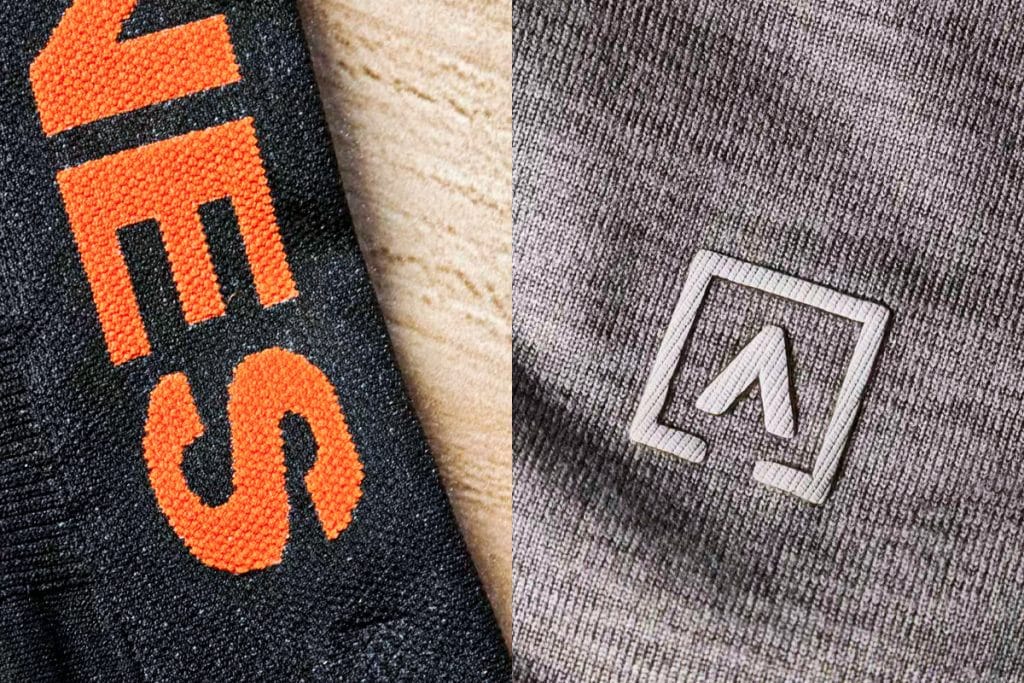
These are the two main ways to put a brand mark on a seamless garment.
| Jacquard (knitted-in) | Heat transfer (applied) | |
|---|---|---|
| How it’s made | Logo is part of the knit program, formed by yarn | Print or film applied with heat and pressure after knitting |
| Best placement | Waistband (double-layer rib) | Body, back, side panels, hem |
| Fine detail | Limited by the stitch grid | Better for thin lines and small text |
| Durability | Part of the fabric, nothing to peel | Depends on application quality and fabric stretch |
| Hand feel | Same as the surrounding fabric | Slight surface layer |
| Design change | New knit program | New transfer artwork |
What our technicians recommend: knit the logo into the waistband, not the body.
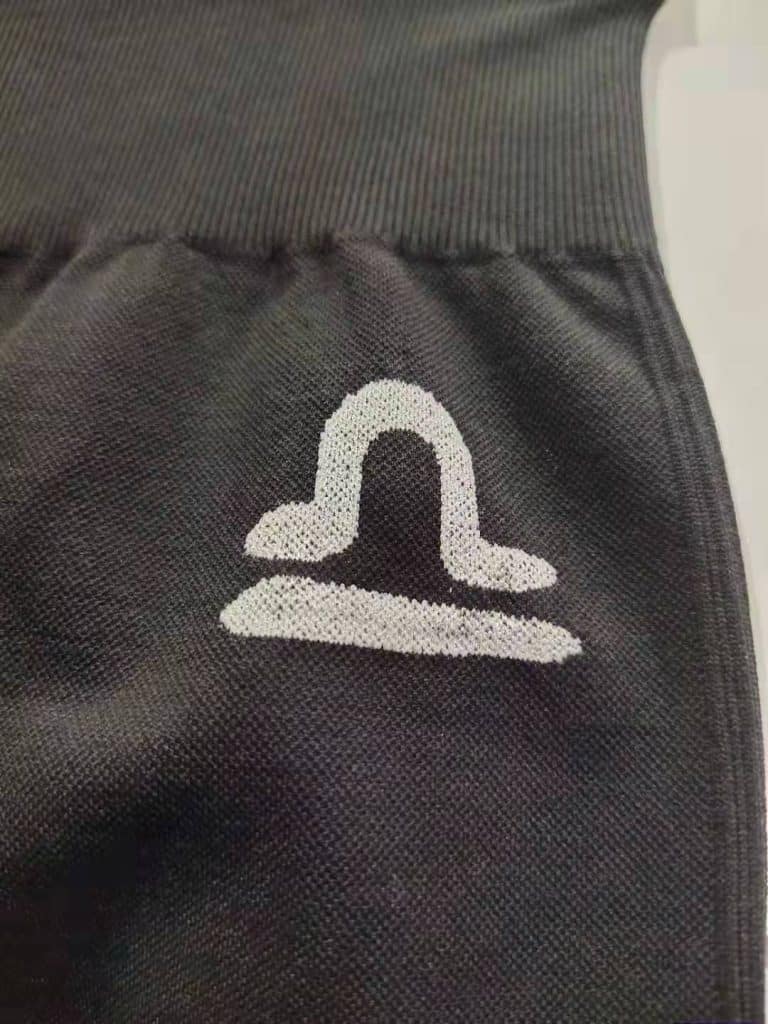
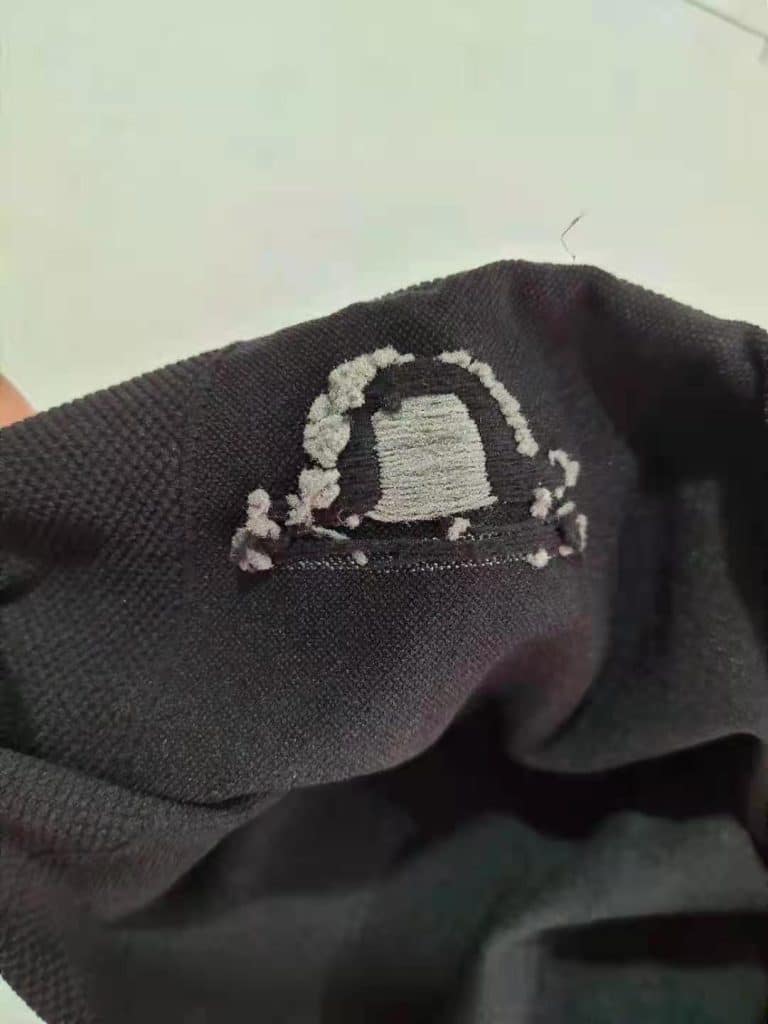
This comes from fabric structure, and you can see it in our own production samples:
- A seamless waistband is normally a double-layer rib. The body is normally single-layer plain jersey.
- On the waistband, the second layer sits behind the logo yarns. The floating yarns on the reverse stay hidden and the logo edges stay sharp.
- On the body there is only one layer. From the front, the logo edges look stepped, like a mosaic. On the reverse, the yarns run across the logo area and look untidy.
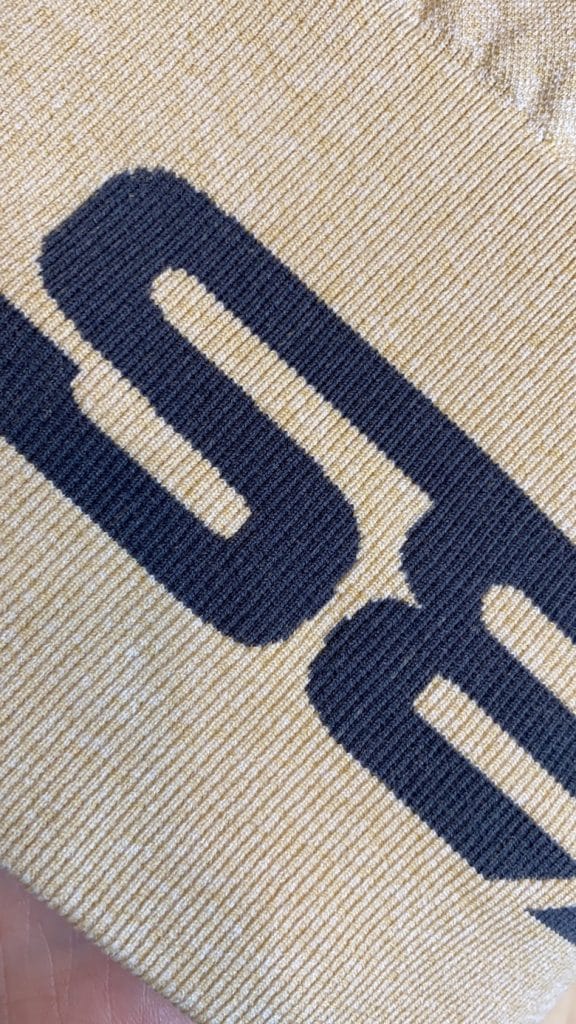
Two more rules from the knitting floor:
- Thinner lines and smaller sizes produce more visible stepping, because every stitch is a visible pixel.
- Complex, multi-part logos need more width. If the logo can’t be larger, heat transfer is usually the better route.
How to get a feasibility check: send your logo draft (vector or high-resolution image) and the width you want, for example 6 cm wide with the height scaled proportionally. Our technicians will confirm whether it will knit cleanly or whether another method suits it better.
Santoni Machine Capabilities for Your Custom Brand
We knit on Italian Santoni SM8-TOP2V and TOP2 FAST machines at 28 gauge (28 needles per inch). Needle count scales with cylinder diameter:
- 13-inch cylinder = 1,152 needles
- Each additional inch of diameter adds 96 needles
- So a 14-inch cylinder has 1,248 needles and a 15-inch cylinder has 1,344
Why this matters to your logo. The needle count defines the pixel grid available for any knitted-in pattern. At 28 gauge, one inch of width holds about 28 stitches. A 6 cm (about 2.36 inch) wide logo therefore has roughly 66 stitch columns to draw its shape. A bold, simple mark has plenty of room. A logo with hairlines or small lettering does not, and no machine can fix that. This is why we ask for the target size before agreeing to knit a logo.
It also explains why a Size M and a Size L are different machine setups, not one program scaled up.
Minimum Order Quantities (MOQ) Explained for Custom Seamless
Our custom seamless MOQ is 500–1,000 pieces per design. A 500-piece order (for example, 3 sizes in 1 color) is the practical balance point. At 600 pieces, we can include 2 colors and 3 sizes. Ready stock is available from 1 piece, and we can arrange your logo, labels and packaging on it.
This is not a sales policy. It follows from how the production works:
1. Cylinder diameter sets size.
Size M and Size L are knitted on different cylinder diameters, so a mixed-size micro-batch means calibrating several machines. Each calibration consumes premium yarn before good product comes out, and that waste is spread over very few pieces.
2. Garment dyeing needs a full vat.
Seamless garments are garment-dyed in industrial vats that require a minimum load to hold the correct liquor ratio. Underfilled vats give uneven color penetration. The usual workaround is adding dummy fabric to fill the vat, which is pure cost.
3. Production tolerances are real.
Knitting and Flatlock stitching both carry defect tolerances such as needle breaks and tension errors. On very small orders these losses become a large percentage of the batch.
4. Certified yarns raise the floor.
GRS-certified and OEKO-TEX® certified yarns can carry higher minimums. If you require certified yarn, expect MOQ at the higher end of the range.
Taken together, 500 pieces lets us run the Santoni cylinders with minimal calibration waste and fill a dye vat efficiently. You get premium quality without carrying a large inventory.
What if you need fewer than 500 pieces? Start from ready stock. It begins at 1 piece, and logo, label and packaging can be arranged, so you can test the market under your own brand before committing to custom development.
What changes MOQ in practice: style complexity, yarn type and certification, number of colors, number of sizes, knit program length, labels and packaging, and depth of customization.
From Tech Pack to Bulk Production
| Step | What happens | Output |
|---|---|---|
| 1. Brief / reference | You send reference images, or a brief with target market and price point | Scope confirmed |
| 2. Tech pack | Measurements, sizes, fabric, colors, logo positions and packaging | Written spec |
| 3. Yarn & knit development | Yarn selection, knit structure and program written | Development file |
| 4. Sample | Knitted, dyed and finished (8–15 days; stock samples 2–3 days) | Physical sample |
| 5. Fit and wash test | Fit review, color and wash check | Approved comments |
| 6. Pre-production (PP) sample | Final confirmation of the bulk standard | Signed PP sample |
| 7. Bulk production | 40–45 days after PP sample approval | Bulk goods |
| 8. Inline QC | Checks during production | Records |
| 9. Final AQL inspection | AQL 2.5 final check | Inspection report |
| 10. Packaging and shipment | Labels, polybags, cartons; DDP options available | Delivered order |
Do you need a tech pack? It is the best protection for your order and prevents most disputes. If you don’t have one, send reference images and target measurements, and we can develop from there.
Our 5-Stage 100% Inspection for Private Label Clients
Every piece is inspected, not sampled. The process has five stages of 100% inspection, and the final audit follows AQL 2.5.
| Stage | Checkpoint | What is checked |
|---|---|---|
| 1 | High-quality fabrics audit | Material availability matches the specification |
| 2 | Cutting precision | Automated panel accuracy check, ±2 mm tolerance |
| 3 | Inline sewing | Stitch strength and durability visual audit, including an elasticity test |
| 4 | Ironing & size | Final measurement verification against the tech pack |
| 5 | Final packaging | Metal detection (needle check) and polybag sealing |
AQL 2.5 is a sampling-based acceptance level for the final audit. It gives you and the factory a written definition of “acceptable.” Because every piece has already been checked at five points, the final audit confirms quality. It is not the first time defects are found.
The metal detection step matters for any brand selling into regulated markets. A broken sewing needle fragment in a garment is a product-safety issue, not just a quality issue.
How to Choose a Seamless Bra Factory in China
Use this checklist with any supplier:
- Own Santoni (or equivalent) machines? Ask which machine models run your type of product, and how many.
- Monthly capacity vs your forecast. Can they deliver at 500 pieces and at 5,000?
- How MOQ is counted: per design, per color, per size?
- Sample and bulk lead times, in writing.
- QC system: inline checks plus an AQL final inspection, with a defined standard.
- Certifications: are the certificates current, and do they carry the manufacturer’s name?
- Written documents: tech pack, sample approval record, written quality standard and production milestones.
- Response time and clarity during quotation. It usually predicts what happens in production.
How YOU Seamless Supports Private Label Brands
- Our own factory, 12,000 ㎡ with 180+ staff, so knitting, sewing and inspection stay under one roof.
- Santoni knitting on SM8-TOP2V and TOP2 FAST machines, with a technical team that will tell you honestly whether your logo will knit well.
- Two entry routes: ready stock from 1 piece (100,000+ pieces in stock, with logo, label and packaging options) to test the market, and custom development from 500 pieces for your own design.
- Sustainable materials: GRS-certified RPET + spandex blends, recycled polyester, recycled nylon and bamboo fiber. See our sustainable activewear manufacturing options.
- Compliance documents: Amfori BSCI, GRS and OEKO-TEX® Standard 100.
- Delivery to your market: specialized shipping lines to Europe, USA, Australia, UK, New Zealand, UAE & SA, with DDP options.
What to Send for an Accurate Quotation
- Product type, with reference images or a tech pack
- Target quantity per style, number of colors and sizes
- Fabric or yarn requirements (including certifications)
- Logo file, target size and placement
- Label and packaging requirements
- Destination country and target delivery date
Frequently Asked Questions
What is the MOQ for private label seamless bras in China?
At YOU Seamless, custom seamless is 500–1,000 pieces per design. 600 pieces can include 2 colors and 3 sizes. Ready stock starts from 1 piece.
Do you offer low MOQ seamless bra manufacturing for startup brands?
Yes, through ready stock. It starts from 1 piece, and we can arrange your logo, labels and packaging. For fully custom development, cylinder setup and dye-vat loading set a floor of 500 pieces. We would rather say that clearly than quote a number that damages quality.
What is the difference between private label, white label, OEM and ODM?
See the comparison table above. In short: white label is the factory’s product with your label. ODM uses the factory’s design with your changes. OEM is built to your design. Private label means the product is sold under your brand.
Can I customize fabric, color, size range, logo, labels and packaging?
Yes, within the limits of the knit structure and order quantity. Logo method depends on placement and complexity (see Jacquard vs heat transfer above).
How long does it take to develop a private label seamless bra sample?
8–15 days for custom development. Stock samples take 2–3 days.
How long does bulk production take after sample approval?
40–45 days after the pre-production sample is confirmed.
What information should I send to get an accurate seamless bra quotation?
Product, quantities, colors, sizes, fabric, logo, packaging and destination. See the list above.
Do you need a tech pack, or can you develop the design from reference images?
Both work. A tech pack gives the most accurate quote and the fewest later changes. Reference images plus target measurements are enough to start.
Can you make seamless sports bras, wireless bras and bra sets under my brand?
Yes. Seamless sports bras, wireless bras and bra sets can be developed under your brand.
How do you control quality from sample approval to bulk production?
The approved pre-production sample is the written standard. Production then goes through 5-stage 100% inspection: fabrics audit, cutting precision, inline sewing, ironing and size, and final packaging. Final inspection follows AQL 2.5.
Can you support recycled nylon, recycled polyester or other sustainable yarns?
Yes. We work with recycled nylon, recycled polyester, GRS-certified RPET + spandex blends and bamboo fiber. If you need a specific certification on the yarn, tell us at the quotation stage, because certified yarns may carry a higher MOQ.
Do you ship worldwide, and is DDP available?
We use specialized shipping lines to Europe, USA, Australia, UK, New Zealand, UAE & SA. DDP (Delivered Duty Paid) options are available.
Start Your Private Label Seamless Project
Send us your reference or tech pack, target quantity and logo file. Our team will reply with a feasibility check and a quotation.
