
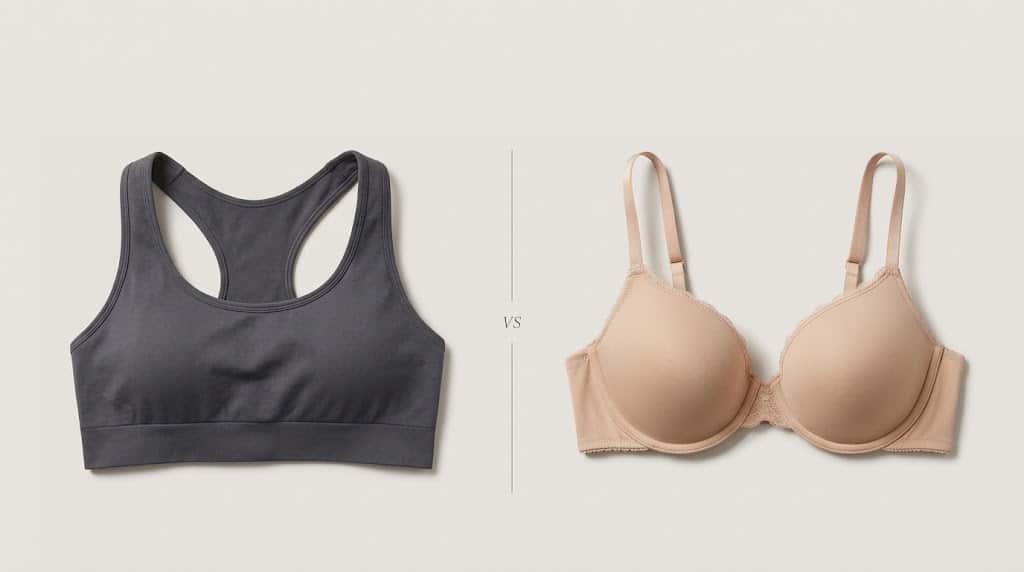
Short answer: A sports bra is engineered to limit breast movement during exercise, using compression or encapsulation, stretch fabric, and moisture management. A regular bra is designed for everyday wear, focusing on shaping, lift, comfort, and appearance. Both can look similar, but they are built for different jobs.
This guide first answers the questions most people ask, then explains what the differences mean if you are building an activewear brand, a gym line, or a studio’s private label.
Sports Bra vs Regular Bra: Quick Comparison
| Feature | Sports Bra | Regular Bra |
|---|---|---|
| Primary purpose | Reduce bounce and support movement | Shape, lift, and daily comfort |
| Support approach | Compression, encapsulation, or both | Cup shaping, underwire, or wire-free structure |
| Typical fabric | Stretch, moisture-wicking blends | Soft, smooth, skin-friendly blends, often lace or microfiber |
| Seams and edges | Flat, low-friction seams to reduce chafing | Decorative or structural seams, sometimes lace trim |
| Straps and band | Wider, often non-slip, stretch-recovery band | Adjustable straps, hooks and closures |
| Best for | Running, HIIT, yoga, gym training | Work, casual wear, evening wear |
| Typical wear time | During activity | All day |
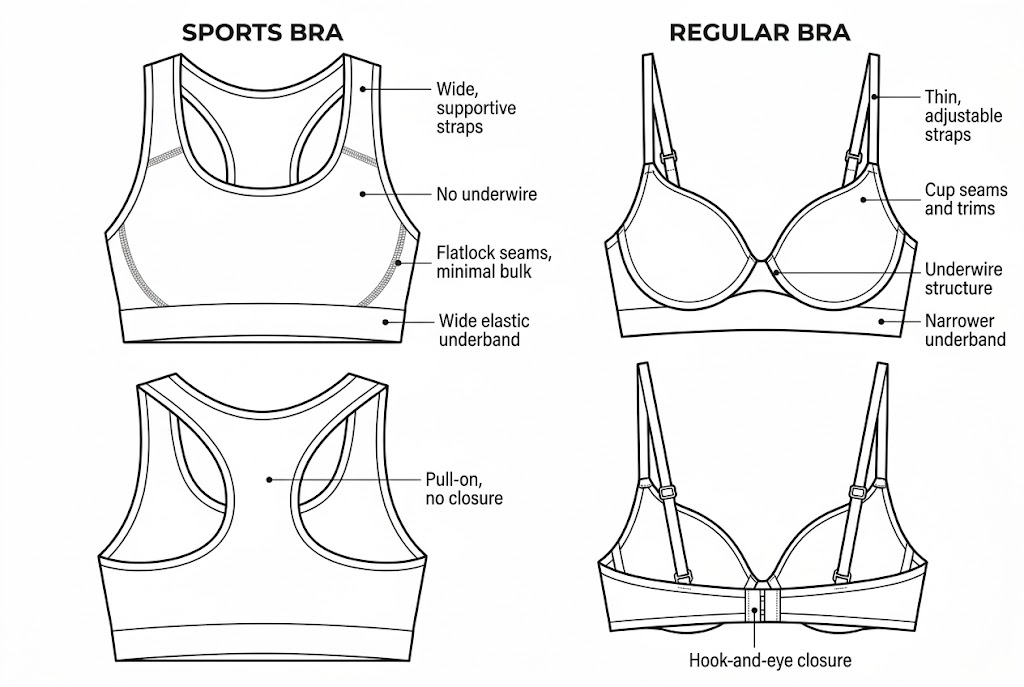
What Is a Sports Bra?
A sports bra is an activewear garment designed to reduce breast movement during physical activity. Support is usually rated by impact level:
- Low impact: yoga, pilates, walking, stretching
- Medium impact: cycling, hiking, gym circuits
- High impact: running, HIIT, jumping, court sports
Construction choices such as compression, encapsulation, band width, strap design, and fabric stretch recovery are all chosen to control movement and keep the wearer comfortable.
What Is a Regular Bra?
A regular bra, often called an everyday bra, is designed for daily wear rather than exercise. Its job is to shape and lift the bust and to feel comfortable for long hours. It often uses molded or padded cups, underwire or wire-free structures, and softer, more decorative fabrics.
Why Do I Need a Sports Bra?
Breasts have no muscle, so they rely on skin and connective tissue for support. During exercise, they move in multiple directions. A sports bra reduces that movement, which can improve comfort and help prevent discomfort during and after activity. Regular bras are not designed for that kind of repeated impact.
Can I Wear a Regular Bra to the Gym?
You can for very light activity, such as a slow walk or gentle stretching, if the bra is comfortable and not too restrictive. For anything involving repeated impact or fast movement, a regular bra is usually not the best choice. Underwires and hooks may dig in, fabrics may trap moisture, and the support is not designed for bounce control.
Sports Bra or Regular Bra for Running?
A sports bra is the better choice. Running is a high-impact activity, so look for a bra with firm support, a secure band, and non-chafing seams. Regular bras are not designed for repeated vertical movement.
Is a Sports Bra Necessary for Yoga?
It is not strictly necessary, but it is recommended. Yoga involves bending, inversions, and stretching, so a low-impact sports bra that stays in place and is comfortable in a range of positions usually works better than a structured everyday bra. Softness, stretch, and a smooth edge matter more than maximum compression.
Best Bra for Running vs Yoga
| Activity | Recommended Bra Type | Key Features |
|---|---|---|
| Running / HIIT | High-impact sports bra | Compression or encapsulation, firm band, secure straps |
| Gym circuits | Medium-impact sports bra | Balanced support, breathable fabric |
| Yoga / pilates | Low-impact sports bra | Soft stretch, flexible straps, smooth seams |
| Office / daily wear | Regular bra | Shaping, comfortable fit |
What Bra Should I Wear for a High-Impact Workout?
Choose a high-impact sports bra with a wide, supportive band, secure straps, moisture-wicking fabric, and flat seams. If possible, test it by jumping or running in place before committing to it. If it still moves excessively, it is not suitable for the activity.
Can You Wear a Sports Bra All Day?
Many people do for comfort. It is generally fine for low-impact sports bras made from soft fabrics, as long as the bra is not too tight and is clean and dry. A high-compression sports bra worn for long hours may feel restrictive. Sports bras are designed primarily for activity, so wear time depends on the design.
For Activewear Brands: What the Difference Means for Your Product Line
If you are launching or expanding an activewear brand, a gym line, or a studio private label, the difference between a sports bra and a regular bra is more than a definition. It affects your fabric choices, pattern development, sampling, cost, and the customer you can serve. This section is written from the factory side. At YOU Seamless, we make both product types in our own factory, so these are decisions we discuss with new brands regularly.
Sports Bra vs Regular Bra: Construction and Fabric Differences for Brands
Fabric. Sports bras prioritize stretch, recovery, and moisture management. Regular bras prioritize softness, drape, and surface appearance. Our fabric options include GRS-certified recycled polyester (rPET) and spandex blends, recycled polyester, and bamboo fiber. Certified yarns can carry higher minimum order requirements, so plan fabric choices early in development.
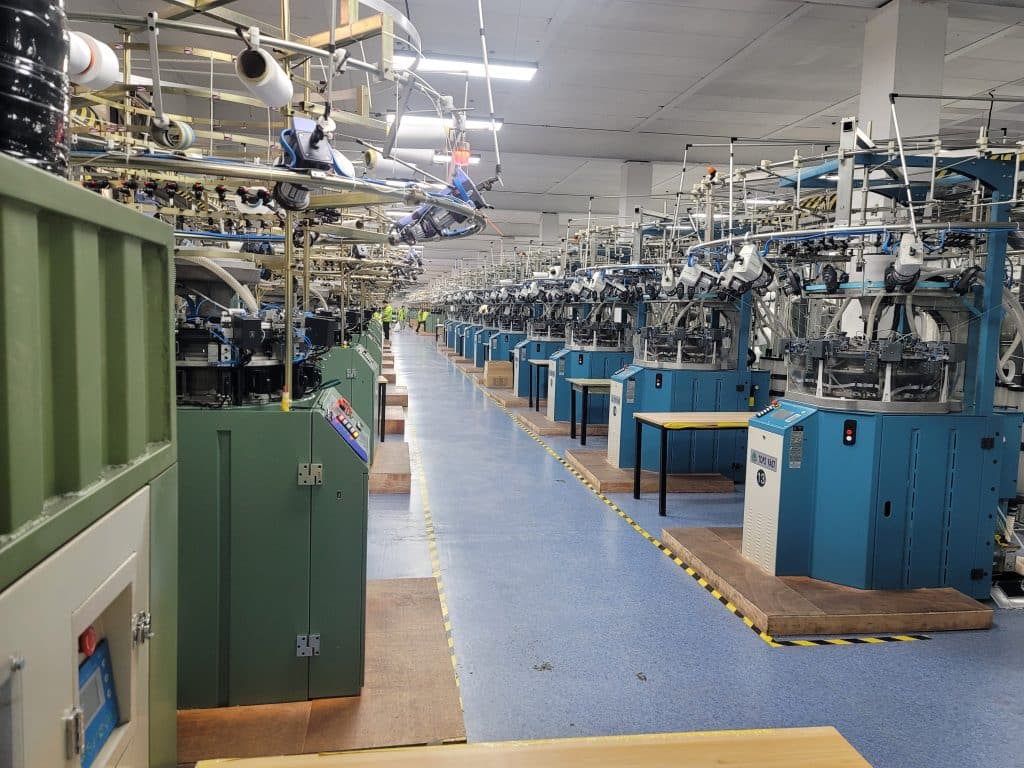
Construction. Sports bras rely on seam placement, band tension, and strap geometry to control movement. Regular bras rely on cup shaping and fit. For seamless sports bras, knitting zones can add targeted compression and breathability without adding seams. We knit on Italian Santoni seamless machines (SM8-TOP2V and TOP2 FAST, 28-gauge), which allow structure and stretch zones to be built into the garment itself. Where stitching is required, we use four-needle six-thread flatlock and three-needle five-thread coverstitch, sewn on Juki and Pegasus machines, to keep seams flat and durable.
Patterning and fit testing. Sports bras need movement testing, not just static fit checks. Regular bras focus more on cup shape and appearance. Plan time for wear testing in your target activity.
Sports Bra vs Regular Bra Manufacturing: Cost Differences
Sports bras are often more complex to develop. Performance fabrics, structural knitting, and more demanding testing can raise both development effort and unit cost compared with a simple everyday bra. The actual difference depends on fabric, construction, trims, and order quantity, so we recommend quoting your specific design rather than relying on general averages.
Support Levels Explained for Brand Planning
Decide your impact level before you design anything.
- Low impact: a good starting point for yoga studios and lifestyle brands, with simpler construction and an easier entry into production.
- Medium impact: suitable for gym and studio brands that serve general training.
- High impact: requires the most testing, since the support must be proven in running and HIIT use.
A common mistake is to launch a “do-it-all” bra. A clear support level and target activity make your product easier to sell and easier to develop.
Common Mistakes Brands Make When Developing Sports Bras
- Copying a bestseller without checking support level. A bra that looks identical but has different construction will not perform the same way.
- Choosing fabric for feel only. Soft fabric that does not manage moisture or hold its shape will disappoint in use.
- Ignoring cup size range. Support needs differ across sizes, and a pattern that works in small sizes may fail in larger ones.
- Skipping real-use testing. Fit models should move, run, or train in the sample.
- Not defining the target activity. Without it, fabric, band, and strap decisions have no direction.
How to Brief a Sports Bra Factory
A clear brief saves sampling rounds. Include:
- Target activity and impact level
- Target customer and size range
- Fabric preference (stretch, weight, certifications)
- Strap and band style
- Padding or cup preferences
- Reference garments or tech packs, if you have them
- Target price range and expected order quantity
If you do not have a tech pack yet, many startups begin with a reference product and a written brief. Our team can help translate that into a development plan.
Sports Bra Sampling Checklist for Brands
Before approving a sample, check that:
- the support level matches your target activity
- fabric stretch and recovery meet your expectations
- seams and edges are comfortable against the skin
- straps and band stay in place during movement
- color, logo placement, and labeling are correct
- the fit works across your size range
MOQ, Samples, and Lead Times at YOU Seamless
| Item | Details |
|---|---|
| Ready stock | From 1 piece |
| Custom seamless | 450–500 pcs per style (600 pcs allows 2 colors and 3 sizes) |
| Development samples | 8–15 days |
| Ready-stock samples | 2–3 days |
| Bulk production | 40–45 days after pre-production sample approval |
Certified materials such as GRS-certified or OEKO-TEX® Standard 100 yarns may require higher minimums. We keep over 100,000 pieces of finished goods and greige fabric in stock, which helps new brands test the market before committing to larger custom runs.
Why Brands Work With Us
- Our own factory: 12,000 m², 180+ employees, established in 2014, with annual capacity of 2.5 million pieces
- Quality control: five-stage, 100% inspection to AQL 2.5
- Certifications: Amfori BSCI, GRS, and OEKO-TEX® Standard 100
- Both product types: sports bras and everyday bras developed under one roof
How to Choose a Sports Bra Factory
Ask any factory:
- Do you own your production, or outsource it?
- What are your MOQs for custom styles?
- How many days does sampling take?
- What quality control process do you use?
- Can you support design and technical development?
- Do you hold the certifications my market requires?
Clear answers to these questions will tell you more than a price quote alone.
FAQ
What is the difference between a sports bra and a regular bra from a manufacturing perspective?
A sports bra is built to control movement, so development focuses on stretch recovery, moisture management, band and strap geometry, and flat seams. A regular bra is built for shaping and daily comfort, so development focuses on cup structure, softness, and appearance. These differences affect fabric choice, pattern work, sampling, and cost.
Should my brand start with a sports bra or a regular bra?
It depends on your customer. Yoga studios and gym brands usually start with low-impact sports bras, which are simpler to develop. Brands serving a broader lifestyle audience may add everyday bras early. Many brands start with one clear support level and expand after the first collection.
How do I choose the right support level for my brand’s sports bra?
Start with your customer’s main activity: low impact for yoga and pilates, medium impact for general gym training, high impact for running and HIIT. High-impact styles need the most testing, so first-time brands often begin with low or medium impact.
Is a sports bra more expensive to produce than a regular bra?
Often, yes. Performance fabrics, structural knitting, and movement testing can raise development effort and unit cost. The actual difference depends on fabric, construction, trims, and quantity, so we recommend requesting a quote for your specific design.
What is the MOQ for a custom sports bra at YOU Seamless?
Custom seamless styles start at 450–500 pieces per style. At 600 pieces, you can include 2 colors and 3 sizes. Ready-stock items are available from 1 piece, which lets you test the market before committing to a custom run.
Do certified fabrics change the MOQ?
They can. Certified yarns such as GRS-certified or OEKO-TEX® Standard 100 materials may require higher minimums than standard yarns. We recommend deciding on certification needs at the start of development.
How long do sampling and production take?
Development samples take 8–15 days, and ready-stock samples take 2–3 days. Bulk production takes 40–45 days after the pre-production sample is approved.
What should I tell the factory when developing a sports bra?
Share the target activity and impact level, target customer and size range, fabric preferences, strap and band style, padding preferences, reference garments or a tech pack, and your target price and order quantity. If you don’t have a tech pack yet, a reference product and a written brief are enough to begin.
Can one factory make both sports bras and everyday bras?
Yes. At YOU Seamless, both are developed in our own factory, which makes it easier to keep fabric, fit, and quality consistent across your line.
Planning a Sports Bra or Everyday Bra Line?
Whether you are launching your first collection or adding styles to an existing line, our team can support you from design to sampling to bulk production.
- Explore [Custom Sports Bra Manufacturing]
- Not sure about quantities or budget? [Contact Us] with your target activity, size range, and estimated order quantity, and we’ll recommend a starting plan.
