
When developing a high-performance activewear line, the quality of the final garment is entirely dictated by its fundamental building blocks. Many brand founders and apparel designers often ask: what is a textile fiber, and how does it determine the stretch, durability, and feel of the fabric?
At YouSeamless, as experts in seamless garment manufacturing utilizing advanced Santoni circular knitting machines, we know that selecting the right raw materials is the first step to a successful product launch. This comprehensive yarn information guide will explain the basics of textile fibers, yarn formation, fineness, twist, and how these elements specifically apply to premium apparel.
What is a Fiber as it Pertains to Textiles?
To understand the fabric, we must look at the microscopic level. What is a fiber as it pertains to textiles? It refers to the raw materials processed from fibers that have a certain strength, fineness, or different appearance structures, and can be of any length. They are the basic units that make up the fabric.
The Role of Yarn
Yarn can directly affect and determine the performance, style, and quality of a fabric by changing its structure, performance, and color. It can also be mixed, compounded, and processed in various ways to obtain an endless variety of colors. Therefore, for fabrics, especially for newly developed products, the design, variation, and application of yarns are very important.
Yarn Formation Process: From Fiber to Yarn
Raw fibers need to undergo several processes to form yarns that meet weaving and knitting requirements. The process from fiber to yarn is called spinning.

- Loosening: The process of breaking large fiber blocks into small pieces and bundles.
- Carding: The process of breaking down small pieces or bundles into a single state, breaking the horizontal connections between fibers.
- Drawing: The process of elongating and thinning a collection of fibers with curved and curly shapes after carding, allowing the fibers to straighten and achieve a predetermined thickness.
- Twisting: The use of rotational motion to twist and rewind a thin strip of fibers around its own axis, fixing the longitudinal connection between the fibers inside the yarn.
YouSeamless Tech Note: While natural fibers require the spinning process above, the synthetic fibers (like Nylon and Spandex) used in seamless activewear do not. They are melted and forced through a spinneret (extrusion) to form continuous, extremely strong filament yarns.
Understanding Yarn Fineness
Yarn is generally measured by fineness, which is the most important indicator of yarn. The finer the yarn, the higher the requirement for fiber quality, and the smoother and more delicate the woven fabric.
Fineness Units
There are four primary units that represent yarn fineness, depending on the types of textile fibers used:
- Yarn Density (Tt): Refers to the mass per unit length of fibers. It describes the fineness of yarn, represented by “tex”. The higher the tex value, the thicker the yarn (e.g., 18tex is thicker than 14tex).
- English Count (S): Generally used for cotton. It refers to the number of “840 yards” in a pound of cotton yarn. The larger the value before “S” (e.g., 60S vs 30S), the finer the yarn.
- Metric Count (N): Generally used for wool fabrics. It refers to the number of lengths of 1kg yarn. A higher “N” value indicates a finer yarn.
- Denier Number (D): Usually used to indicate the thickness of continuous filaments (natural silk and synthetic filaments). Denier refers to the weight of a 9,000-meter-long fiber in grams. The larger the number before “D”, the thicker the fiber.
(Unit Conversions: 1S = 1.69N | 1N = 0.59S | Tt = 583.1/S | Tt = 1000/N)
Seamless Engineering Application: In our Santoni machines, matching the correct Denier to the machine gauge (e.g., 28-Gauge) is vital. A 70D nylon yarn is specifically selected for heavy-duty, 100% squat-proof yoga leggings. Conversely, a lower Denier (like 40D or 30D) is utilized for lightweight, breathable summer sports bras.
How Fineness Affects Clothing
- Appearance & Style: Fine yarn fabric is delicate, smooth, and lightweight, reflecting a luxury style. Thicker yarn makes the fabric fluffy, rough, and casual, reflecting a relaxed style.
- Texture & Properties: Finer yarns feel softer and have better drape. However, coarser yarns often have better wrinkle resistance. For warmth, coarse yarns with larger gaps hold more air and provide better warmth retention. For pilling, fine yarns with long fibers are less prone to pilling compared to coarse, short-fiber yarns.
- Fabric Cost: The finer the fabric yarn, the higher the fiber grade required, the longer the processing techniques, and the more expensive the weaving cost.
The Science of Yarn Twist
Twisting rotates the single yarn in one direction to make the fibers tightly fit, increasing fastness, elasticity, and smoothness.
Twist Direction
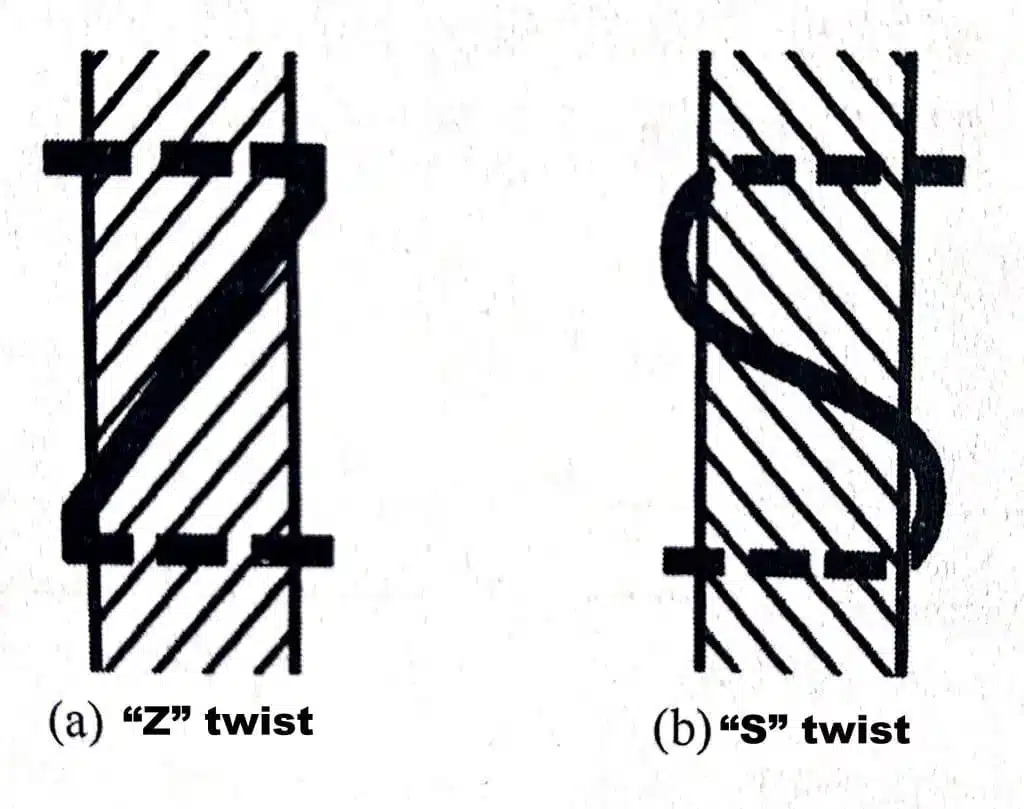
- “Z” Twist (Left-hand twist): Twisted from bottom to top, left to right.
- “S” Twist (Right-hand twist): Twisted from bottom to top, right to left.
YouSeamless Tech Note on Tube Torque: In circular seamless knitting, balancing S-twist and Z-twist yarns is critical. If unbalanced, the final seamless tube will suffer from “Spiraling”—meaning the leg of your leggings will twist after washing. Our engineers meticulously control this to ensure structural integrity.
Twist Levels and Impact on Fabrics
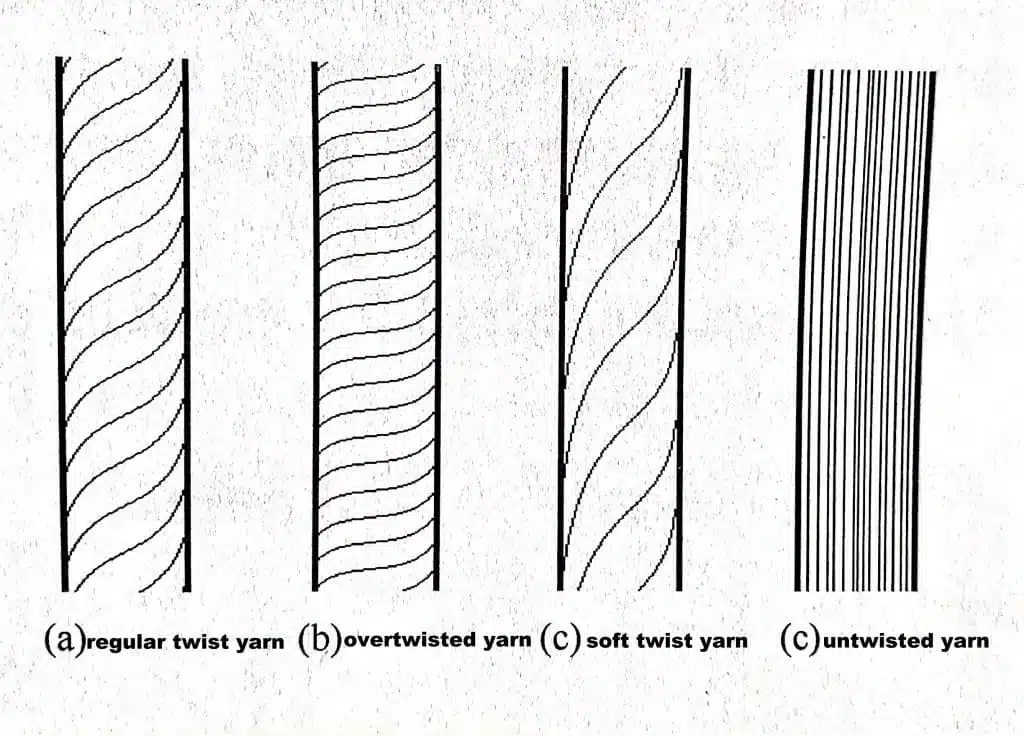
- Regular Twisted Yarn: Has normal twist, providing a comfortable feel and smooth surface for standard clothing (plain cloth, poplin, khaki).
- Overtwisted Yarn: Has a twist greater than normal, resulting in high strength and a cooler, crisper feel. Perfect for thin, highly breathable summer fabrics (chiffon, georgette).
- Soft Twist Yarn: Has less twist, resulting in a loose, soft, and warm feel (plush, flannel). However, fiber hairiness is more prone to protrude, causing pilling.
- Untwisted Yarn: Has zero twist. Sometimes used with long filament yarn to create a bright, smooth, and highly lustrous fabric surface like satin.
Types of Textile Fibers: Exploring Yarn Shapes
Beyond fineness and twist, the physical shape of the yarn dramatically affects the final product. Understanding these types of textile fibers is crucial for B2B apparel sourcing.
- Staple Yarn: Spun from fibers with lengths similar to cotton, linen, or wool. They offer high breathability but the overall utilization rate of fiber strength is lower.
- Filament Yarn: Continuous strands (like silk or synthetic nylon/polyester) over 800m long. Highly parallel, tight, and strong. They are the backbone of seamless compression wear.
- Textured Yarn (DTY/ACY): A chemical fiber filament that undergoes spatial curling and deformation. It achieves the fluffiness, softness, and warmth of staple yarn but with superior synthetic stretchability.
- Covered Yarn (SCY/DCY): The absolute core of seamless stretch. Bare spandex must be wrapped in nylon. Single Covered Yarn (SCY) provides standard elasticity, while Double Covered Yarn (DCY) wraps it twice for intense recovery in high-compression leggings.
- Bulk Yarn: A mixture of high and low shrinkage fibers. When heated, it becomes bulky, soft, and warm (mainly acrylic fiber).
- Profile Fiber Yarn: Spun from shaped fibers, drastically changing the luster and feel, often used to mimic animal fur.
- Superfine Fiber Yarn (Microfiber): Ultra-fine fibers that far exceed ordinary fibers in thinness, providing incredible water absorption and buttery-soft coverage.
Fiber Content of Clothing and Plating Technology
The ultimate performance and cost of your activewear are directly tied to the yarn you select. The exact fiber content of clothing—whether it is a blend of 90% Micro-Nylon and 10% Spandex for buttery softness, or a high-denier blend for maximum compression—dictates the drape, elasticity, and manufacturing cost.
Furthermore, using advanced Plating techniques on our Santoni machines, YouSeamless can knit the fabric so that the durable Nylon sits on the outside (for abrasion resistance), while the soft, moisture-wicking Elastane stays on the inside (closest to the skin).
Ready to Engineer Your Next Seamless Collection?
Choosing the wrong yarn or an inexperienced factory can lead to twisted leggings, poor fit, and high defect rates. Do not leave your fabric performance to chance. Partner with a true seamless technology expert who understands the engineering behind every stitch.
[Contact the YouSeamless Engineering Team today] for a free fabric consultation, request our exclusive Seamless Yarn Swatch Book, or send us your Tech Pack for a quick, accurate sampling quote!
