
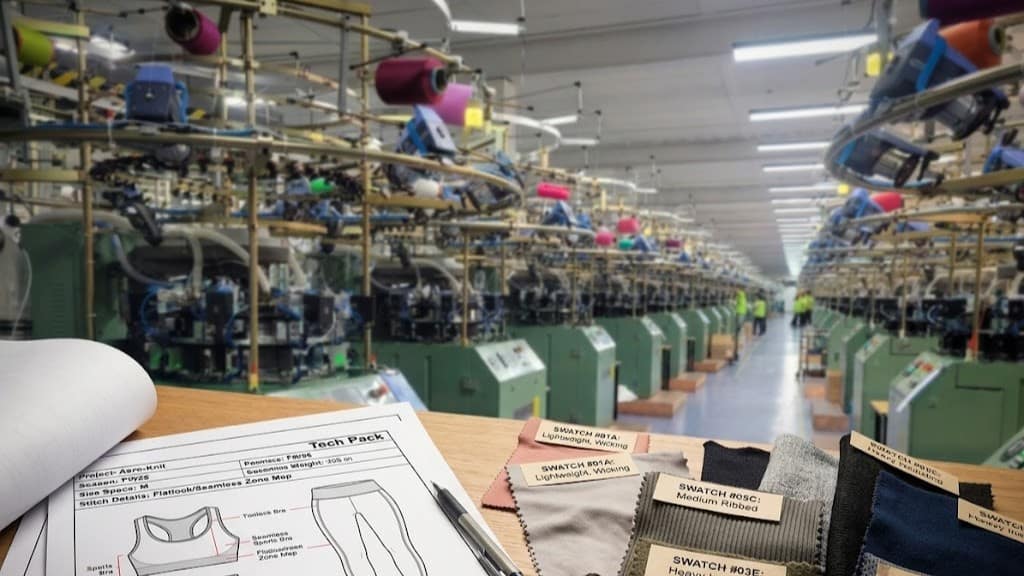
For activewear brand owners, product developers, and technical designers, understanding the gsm meaning in fabric is a crucial factor in the garment development process. Whether you are engineering high-compression yoga pants or moisture-wicking sports bras, selecting the perfect fabric requires a deep understanding of material specifications.
If you want to communicate effectively with your manufacturing partners, control bulk production costs, and ensure exceptional product quality, you must know exactly what is gsm in fabric. In this comprehensive B2B guide, YouSeamless—your global expert in engineering-grade seamless activewear knitting—breaks down the essential concepts of fabric weight, density, and manufacturing considerations.
The Definition: Understanding Fabric Weight
To begin, what exactly does gsm stands for? The gsm full form is grams per square meter. It is the global metric measurement that dictates how much a one-square-meter piece of fabric weighs.
When looking at the gsm fabric grams per square meter definition textile professionals use, it acts as a standardized indicator of fabric thickness, density, and durability. A lower gsm equates to lighter fabrics and lightweight fabrics (ideal for high breathability and hot weather), whereas a higher gsm results in thicker, heavier fabrics that offer more structure and warmth.
In some regions, you may also see fabric weight measured in ounces per square yard (oz/yd²), but the gsm grams per square meter fabric weight definition textile standard remains the most universally accepted metric for B2B procurement.
While a 100 GSM material might be perfect for a floaty blouse, t shirts, or summer dresses, and a 500+ GSM material is reserved for winter clothes, heavyweight denim trousers, canvas, or upholstery, athletic wear demands a highly specific and functional balance.
What is GSM in Knitted Fabric? (The Seamless Angle)
As a brand exploring high-end activewear, you might be asking: what is gsm in knitted fabric, and how does it differ from traditional woven textiles?
In traditional cut-and-sew manufacturing, brands purchase pre-made rolls of fabric with a set GSM. However, in seamless activewear manufacturing, we engineer the garment from the yarn up. At YouSeamless, using state-of-the-art circular knitting technology like Santoni machines, fabric weight is a highly dynamic parameter.
By precisely manipulating yarn tension control, fiber type (such as blending high-grade nylon, polyester, and spandex), and the knitting structure (the weave or knit pattern), we actively determine the GSM during the production process. This allows us to achieve the best gsm for your specific design, ensuring the garment offers the exact compression, drape, and stretch your brand requires without compromising on fabric quality.
Choosing the Right Fabric Weight for Activewear
Selecting the right fabric weight is intrinsically linked to the intended use of the garment. Even if two fabrics use the same gsm, different materials will yield different results. However, as a baseline for seamless athletic wear, here is how you should evaluate GSM:
What does 250 GSM mean in fabric?
When developing premium yoga pants or gym leggings, what does 250 gsm mean in fabric? In the activewear industry, a 250 to 300 GSM range is the golden standard for squat-proof performance. A higher gsm fabric in this range provides maximum durability, excellent muscle compression, and complete opacity (non-see-through) during intense workouts.
What is 230 GSM in fabric?
If your product line includes tops or sports bras, you might wonder, what is 230 gsm in fabric? This represents an ideal medium weight material. At 230 GSM, the fabric offers light-to-medium support, exceptional breathability, and a soft hand-feel that won’t feel overly restrictive. It is the suitable choice for seamless sports bras and athletic crop tops.
How GSM Affects Your B2B Bulk Manufacturing Costs
Understanding what is gsm in fabric weight is not just about product performance; it directly impacts your B2B supply chain, pricing strategy, and MOQ (Minimum Order Quantity).
- Raw Materials: A higher gsm requires more raw materials (more yarn per square meter). Consequently, heavier seamless garments will incur higher material costs.
- Manufacturing Time: Knitting heavier, denser fabrics on Santoni machines often requires slower operational speeds to maintain precise tension control, which can increase the overall production cost per unit.
- MOQ Implications: Because specific GSMs require exact yarn blends and machine calibrations, factories may require higher MOQs to offset the setup time for custom weights. Understanding this relationship helps you evaluate the true cost performance of your bulk orders.
GSM in Fabric How to Calculate: The B2B Quality Control Method
For B2B buyers conducting quality control on factory samples, gsm in fabric how to calculate is a standard operating procedure. While factories often use a specialized gsm cutter to punch out a perfectly sized sample, you can determine the weight manually using this elevated method:
- Prepare the Sample: Obtain a clean, dry, and flat fabric sample free of wrinkles.
- Measure the Surface Area: Use precise industrial rulers to measure the exact length and width of the sample in centimeters to calculate the surface area.
- Weigh the Fabric: Place the sample on a highly calibrated digital laboratory scale in a windless environment to find out exactly how much the fabric weighs. Record the weight in grams.
- Calculate the GSM: Divide the weight (in grams) by the area (in square meters). Formula: Weight (g) / Area (m²) = GSM. (For example, if a 1m x 1m sample weighs 250 grams, the fabric is exactly 250 grams per square meter fabric).
Standard Fabric GSM Reference for Designers
While synthetic fibers dominate activewear, understanding how different weights apply across textiles provides excellent context for product developers. Here are general reference ranges across various materials:
- Lace & Silk: 10g/㎡ – 50g/㎡ (Ultra-lightweight, sheer)
- Linen & Cotton: 100g/㎡ – 300g/㎡ (Light to medium weight, highly breathable)
- Nylon & Polyester: 40g/㎡ – 300g/㎡ (Highly versatile; 200-300 GSM is standard for premium activewear)
- Wool & Twill: 200g/㎡ – 600g/㎡ (Heavy, high warmth, durable)
Note: These are baseline industry averages. Other factorslike yarn treatments and knit structures will ultimately define how the fabric drapesand performs.
Frequently Asked Questions (FAQs)
What is the best GSM for squat-proof seamless leggings?
For premium, squat-proof seamless leggings, a fabric weight between 250 GSM and 300 GSM is the industry standard. This higher gsm fabric ensures complete opacity during deep stretches, provides excellent muscle compression, and maintains structural integrity through rigorous workouts.
Does changing the GSM affect my bulk order’s MOQ (Minimum Order Quantity)?
Yes, it can. In seamless manufacturing, altering the fabric weight often requires recalculating the yarn tension on our Santoni machines and adjusting the exact blend of raw materials (like nylon and spandex). If you require a highly customized GSM outside of standard activewear ranges, it may necessitate a higher MOQ to justify the machine setup and custom yarn procurement.
Is a higher GSM always better for athletic wear?
Not necessarily. The best gsm depends entirely on the garment’s intended use. While a heavier material is excellent for durable, high-compression bottoms, it lacks the high breathability needed for heavy-sweat activities. For items like running tops or lightweight sports bras, a lower GSM (such as 180 to 230 GSM) is far more suitable to ensure moisture-wicking and comfort.
Can YouSeamless match the GSM of a fabric sample I provide?
Absolutely. If you have a physical sample of a garment you love, our engineering team can evaluate it, determine its exact grams per square meter, and reverse-engineer the knit structure and yarn blend to replicate or even improve upon that fabric quality for your custom production run.
Partner with the Global Seamless Expert
Understanding what is gsm in fabric is the first step to building a world-class activewear brand. The next step is partnering with a manufacturer who can execute your vision with precision.
As your global seamless tech expert, YouSeamless specializes in engineering-grade activewear. We don’t just cut and sew; we utilize advanced circular knitting technology to build your garments yarn by yarn, ensuring the perfect weight, stretch, and performance for every piece.
Stop guessing with your tech packs and start engineering with the experts.
- Get a Custom Quote: Share your tech packs, target GSM, and order volumes, and we will provide a detailed manufacturing breakdown.
- Discuss Your MOQ: Let’s find the most cost-effective production strategy for your brand’s growth.
[Contact YouSeamless Today] and let’s bring your next seamless activewear collection to life!
