
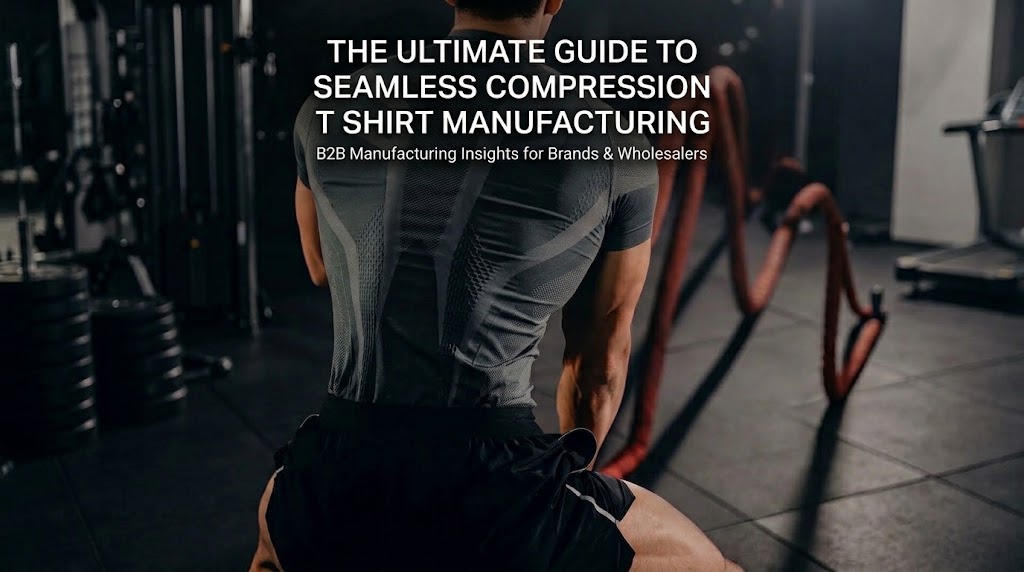
Choosing a compression t shirt manufacturer is not the same as choosing a regular apparel supplier. Compression wear is a performance product — fit, pressure distribution, stretch recovery, and seam construction all directly affect whether a customer keeps wearing it or returns it. For brand owners and purchasing managers evaluating a wholesale compression shirts manufacturer, the real question is not “can you make a tight t-shirt,” but “can you reproduce the exact compression, fit, and durability of your approved sample across every unit in a bulk order, batch after batch.”
At YOU Seamless, compression wear is not a side category — it is built directly into our seamless knitting programs, running on Santoni seamless machines in our own factory. This guide walks through the technical decisions that separate a reliable manufacturer from one that will cause fit complaints, wash-out compression, and returned inventory.
What B2B Buyers Complain About When Sourcing Wholesale Compression Shirts
Most quality disputes in compression wear are not about obvious defects like loose threads. They come from inconsistencies that only appear once garments are worn, washed, or produced at scale. The most frequent issues we see reported across the industry include:
Inconsistent compression between bulk units — the sample feels snug and supportive, but bulk units feel looser. This is usually caused by yarn lot variation, inconsistent elastane tension, or knitting density drifting between production runs. The fix is locking the yarn lot, knitting program version, and garment GSM before bulk starts, and keeping batch test records.
Loss of stretch recovery after washing — the shirt loosens at the collar, cuffs, or torso after a few wash cycles. This points to insufficient heat-setting or poor elastane quality. Buyers should request stretch-and-recovery data after wash cycles, not just a “four-way stretch” claim on a spec sheet.
Size grading that breaks down at the extremes — S sizes feel overly tight at the underarm, while XL/XXL loses compression and support. This happens when a factory simply scales a base pattern up or down instead of re-engineering knitting density and compression zones for each size. Buyers should insist on physical samples across at least S, M, L, and XL — not approval based on a single M sample.
Chafing at underarm, shoulder, or side-seam areas — common in traditional cut-and-sew construction where seam placement and flatness weren’t tested against real movement. Overhead reaches, push-ups, rowing motions, and running arm swings should be part of wear testing before approval.
Pilling, snagging, or color show-through — usually traced to yarn denier mismatch, twist and structure incompatibility, or insufficient dyeing and finishing. Pass/fail standards should be specified in the tech pack, not left to subjective judgment.
Cracking logos or heat-transfer prints — high-stretch fabric combined with the wrong printing method causes prints to crack or peel after stretching and washing. This should be tested in a stretched state after multiple wash cycles, not just on a flat, unstretched sample.
On the testing side, it’s worth being direct about where the line currently sits. Our standard AQL 2.5 inspection focuses on visual and construction defects — holes, stains, stitching faults, and similar issues. Stretch-and-recovery rate is not currently part of our routine in-house testing. For compression wear, where stretch recovery is a functional performance metric rather than a cosmetic one, we recommend third-party lab testing through SGS, Intertek, or BV, referencing ASTM D2594 or ISO 13934-1. A number of our premium brand clients request this type of report, and we coordinate lab submissions on their behalf. We’d rather tell you this upfront than let you discover it after a bulk order ships.
Seamless vs. Cut-and-Sew Compression T-Shirts: Which Construction Fits Your Brand?
Seamless knitting and traditional cut-and-sew are both valid approaches — the right choice depends on what your compression shirt needs to do.
In seamless construction, the garment body is knitted as a continuous tube on a circular knitting machine, largely eliminating the main body side seams. This reduces friction points at the torso and allows different knit structures — denser, more compressive zones and more open, breathable zones — to be programmed into a single garment without cutting and sewing separate panels together.
Traditional cut-and-sew relies on pattern pieces, fabric elasticity, and seam placement to create compression and shape. It remains the more practical choice for designs involving heavy color-blocking, complex panel work, mesh insertions, or when a brand wants to use an already-validated woven or circular-knit fabric rather than developing a new seamless program.
The honest comparison looks like this:
| Aspect | Seamless Knitting | Cut & Sew |
|---|---|---|
| Body structure | Continuous knit tube, minimal main seams | Multiple panels sewn together |
| Fit control | Adjusted through knit density and structure zones | Adjusted through pattern, fabric stretch, and seam placement |
| Compression zoning | Different structures knit directly into target zones | Typically requires separate fabric panels for zoning |
| Friction risk | Lower, fewer body seams | Depends on seam flatness and placement quality |
| Design freedom | Constrained by machine gauge, cylinder diameter, and program complexity | Greater freedom for color-blocking and complex panels |
| Material waste | Lower, garment is knit close to final shape | Higher, from pattern cutting waste |
We build our production around seamless technology because it suits the core promise of compression wear — a close, low-friction, second-skin fit with zone-specific support. But it’s worth saying clearly: seamless is not automatically “better” in every case. If your design depends on heavy paneling or fabric you’ve already validated elsewhere, cut-and-sew may genuinely be the more practical route.
How Our 28-Gauge Santoni Machines Control Compression Zones
We run Santoni SM8-TOP2V and TOP2 FAST seamless knitting machines at 28 gauge, with a 13-inch cylinder producing 1,152 needles (each additional inch of cylinder diameter adds roughly 96 needles). But it’s important to be precise about what this actually delivers.
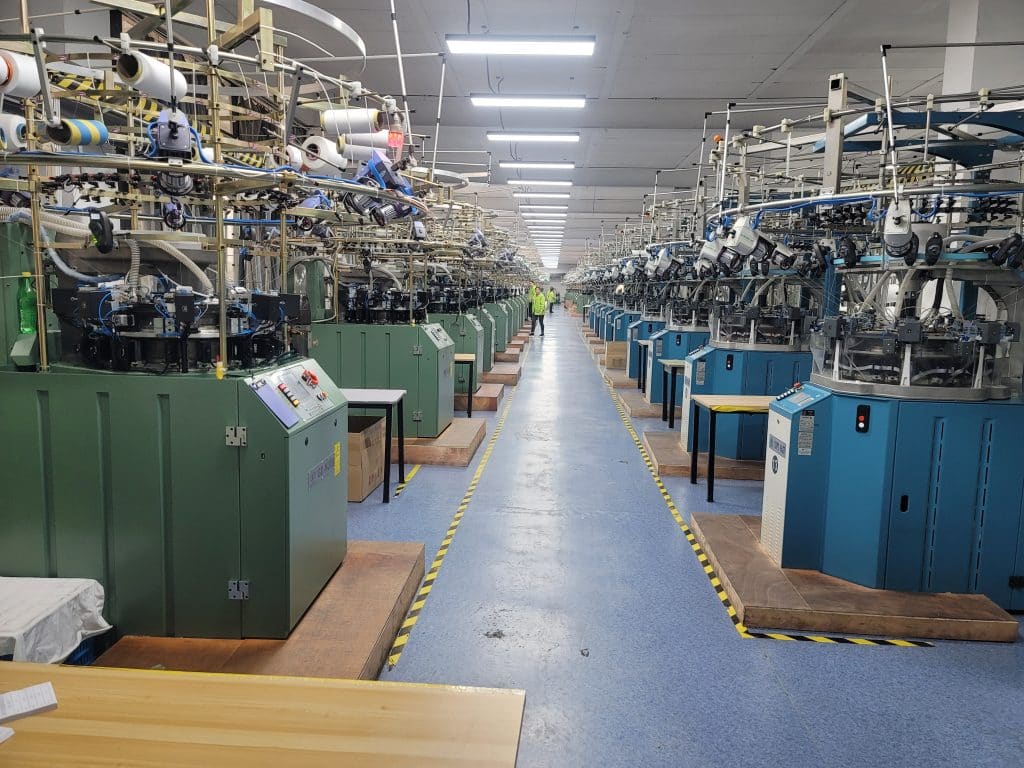
A 28-gauge machine improves resolution, not performance by itself. Compression performance still depends on yarn denier, elastane tension, stitch density, body-zone programming, heat setting, and size-specific engineering. The finer needle gauge lets us produce a smoother surface, more precise ventilation meshes, and more finely tuned compression textures — but the machine alone doesn’t guarantee a well-fitting compression shirt.
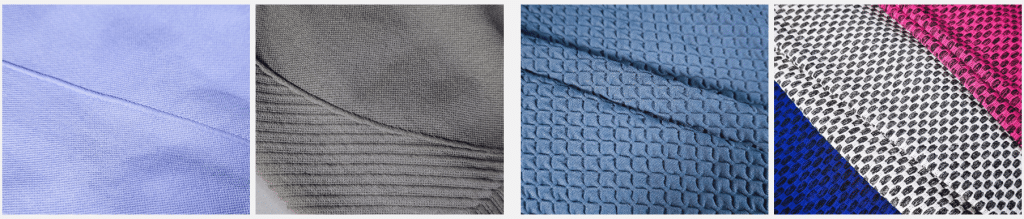
Here’s something our knitting technicians are specific about: when a buyer wants stronger compression at the waist or core while keeping the chest more elastic and unrestrictive, the primary lever is not simply adjusting yarn tension or elastane denier. It’s done through switching stitch structures across zones — denser rib or contraction structures are programmed into the waist area, while the chest zone retains a more open, elastic knit structure. This zone-based approach is part of what we document as our Seamless Compression Zones system, which we can walk you through with reference diagrams during development.
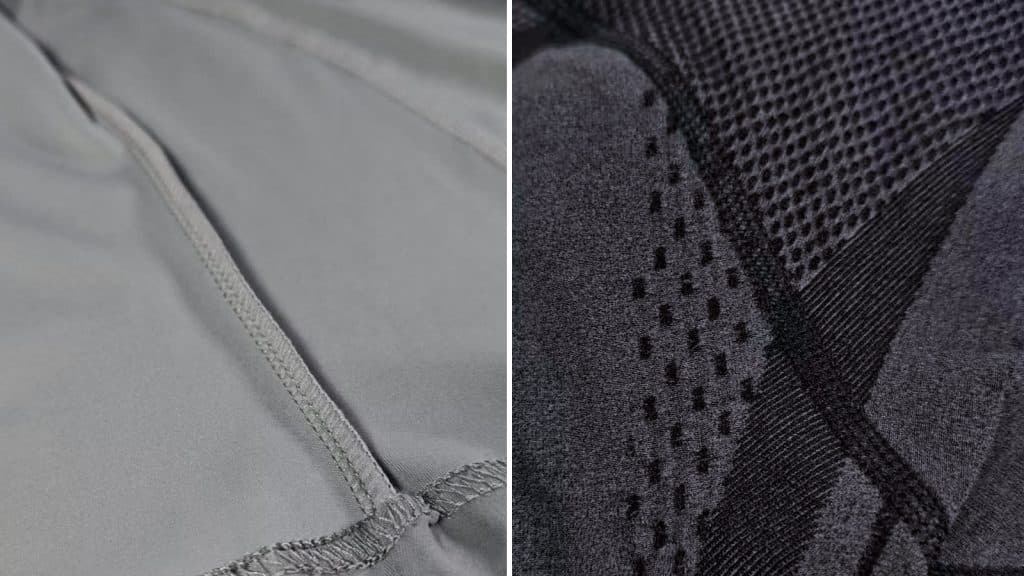
Why flatlock stitching matters at the neckline and armholes. Even in a fully seamless garment, the neckline and armholes still require sewing — done on Juki or Pegasus machines. The stitch type here has a real impact on wearer comfort. We use 4-needle 6-thread flatlock construction as our signature method, which joins fabric edges together (butt-join) rather than overlapping them, keeping the seam nearly flush with the fabric surface. Under compression, a raised seam becomes a pressure line that causes chafing or blistering during movement — flatlock avoids this, and stretches synchronously with the fabric so the seam never restricts recovery. Our 3-needle 5-thread coverstitch option is flatter to produce and performs well for general activewear worn for shorter periods. For professional-grade compression wear — competition gear, or base layers worn for hours in marathons, triathlons, or MMA training — the added durability and reduced friction of 4-needle 6-thread flatlock make a measurable difference in comfort over time.
What Spandex Percentage Works Best for Muscle Fit Compression Shirts
There’s no single “correct” elastane percentage for every compression shirt — it depends on the intended use.
For a men’s muscle-fit compression t-shirt built for gym training, functional fitness, or everyday athletic wear, 15%–18% elastane blended with nylon or polyamide is typically a practical development starting point. This range tends to balance close-body compression with freedom of movement, breathability, and wash durability. Brands seeking a stronger shaping or higher-compression feel sometimes move toward 18%–22%, though we’d caution against treating higher elastane content as automatically “better” — it often trades off breathability and wearability, especially for garments worn during high-intensity movement.
It’s also worth being clear that elastane percentage alone doesn’t determine how a shirt actually feels on the body. The real compression outcome is a combination of yarn denier, elastane feed tension, knit structure, stitch density, garment negative ease, heat-setting, and how well the pattern is sized for the wearer. Two shirts labeled “82% nylon / 18% spandex” can feel completely different depending on these variables — which is exactly why sample approval and locked production parameters matter more than a percentage on a spec sheet.
Recycled Fabric Without Compromising Compression Performance
Sustainability requests are increasingly common, and GRS-certified recycled polyester (RPET) is a fabric option we produce regularly. Performance-wise, RPET is close to virgin polyester for compression wear — the difference in tensile strength and elastic recovery is within about 3%, which is imperceptible in actual wear.
The practical differences sit on the sourcing side rather than the performance side. GRS RPET typically requires a higher MOQ — around 1,000–2,000 pieces per style, compared to 500–600 pieces for virgin polyester. Heat-setting temperatures need to run slightly lower, and pre-treatment before dyeing needs to be reinforced. Certification traceability across the entire yarn-to-garment supply chain also adds documentation work, though it doesn’t slow down production once the chain is set up. If sustainability is part of your brand positioning, this is worth factoring into your order quantity planning early rather than discovering it mid-negotiation.
Compression Shirts Built for Different Training Demands
Compression shirts aren’t a one-size-fits-all product across sports. A shirt built for BJJ or MMA training needs to withstand grappling friction, repeated stretching, and close-contact grip without seams digging in. Basketball and running compression tees prioritize breathability and freedom for overhead arm swings and shoulder rotation. Gym and strength training shirts often prioritize core and chest compression for a muscle-fit silhouette without restricting pressing or pulling movements.
This is where zone-based seamless knitting has a practical advantage — a single tech pack can specify tighter compression across the torso for support, while easing structure at the shoulders and underarms for range of motion, without needing separate fabric panels. We produce both short sleeve and long sleeve compression styles across these use cases, adjusting zone placement based on the primary movement pattern of the sport.
Questions to Ask Before Placing a Bulk Compression Wear Order
Experienced brand owners rarely ask only about price and MOQ. The questions that actually protect your order tend to fall into three groups:
On product development:
- Can compression levels differ across the chest, abdomen, back, and sleeves without restricting overhead movement?
- What yarn composition, denier, and garment GSM do you recommend for a gym-focused muscle-fit compression tee?
- Can you provide stretch-and-recovery data after washing, rather than a general “four-way stretch” claim?
- Are knitting programs adjusted individually per size, or is one program scaled across S–XXL?
On sample-to-bulk consistency:
- Will the yarn lot, elastane spec, and knitting program version be locked before bulk production starts?
- What exactly changes between the development sample and bulk production?
- How is shade variation controlled across nylon, polyester, elastane, and mesh components in the same garment?
On quality and compliance:
- What is your AQL standard, and which defects are classified as critical vs. minor?
- Can you provide GRS, OEKO-TEX, or BSCI documentation for certified materials?
- What is the real MOQ per style, color, and size — including any minimum yarn-dyeing quantity that affects final order size?
If a supplier can’t answer these with specifics — measurable specs, sample data, documented processes — rather than general reassurances, that’s a signal worth paying attention to before committing to a bulk order.
Our Manufacturing Capabilities at a Glance
| Factory Fact | Detail |
|---|---|
| Established | 2014 |
| Factory area | 12,000㎡ |
| Employees | 180+ |
| Annual capacity | 2.5 million pieces/year |
| In-stock inventory | 100,000+ finished units/greige fabric |
| Knitting equipment | Santoni SM8-TOP2V & TOP2 FAST, 28-gauge |
| Signature stitching | 4-needle 6-thread flatlock, 3-needle 5-thread coverstitch (Juki, Pegasus) |
| Quality inspection | 5-stage 100% inspection, AQL 2.5 |
| Certifications | Amfori BSCI, GRS, OEKO-TEX Standard 100 |
| Sampling lead time | 8–15 days (development), 2–3 days (in-stock samples) |
| Bulk lead time | 40–45 days after PP sample confirmation |
| Custom MOQ | 450–500 pieces/style (600+ pieces enables 2 colors, 3 sizes) |
Custom and Wholesale Options for Your Brand
If you’re developing a full compression wear line rather than a single style, we also produce a broader range of related products under our own factory — including custom compression shirts and wholesale compression shirts, along with blank compression shirts for private label, muscle fit t shirts, seamless t shirt bases, and mens muscle fit shirts for gym and athletic brands. These share the same seamless knitting infrastructure and quality process described above.
FAQ
What is the MOQ for a compression t-shirt manufacturer?
Custom seamless compression styles typically start at 500–1000 pieces per style. Ordering 600+ pieces allows flexibility for 2 colors and 3 sizes within one production run.
How long does sampling take?
Development samples typically take 8–15 days. If you’re working from an existing in-stock style, samples can be turned around in 2–3 days.
Do you test stretch and recovery in-house?
Our standard AQL 2.5 inspection covers visual and construction defects. Stretch-and-recovery testing is available through third-party labs (SGS, Intertek, BV) referencing ASTM D2594 or ISO 13934-1, and we assist with coordinating these reports for clients who require them.
Can you produce GRS-certified recycled fabric compression shirts?
Yes. GRS RPET performs within about 3% of virgin polyester in stretch and recovery. It typically requires a higher MOQ (1,000–2,000 pieces per style) and slightly adjusted heat-setting parameters.
What’s the difference between 4-needle 6-thread and 3-needle 5-thread stitching?
4-needle 6-thread flatlock keeps seams nearly flush with the fabric, reducing chafing under compression — ideal for long-duration wear like marathons or MMA training. 3-needle 5-thread coverstitch is a lighter, more economical option suited to general activewear.
Ready to develop your compression wear line?
Send us your tech pack, target compression zones, size range, color plan, and estimated order quantity — our team will review manufacturability and get back to you with sampling timelines and pricing.
