
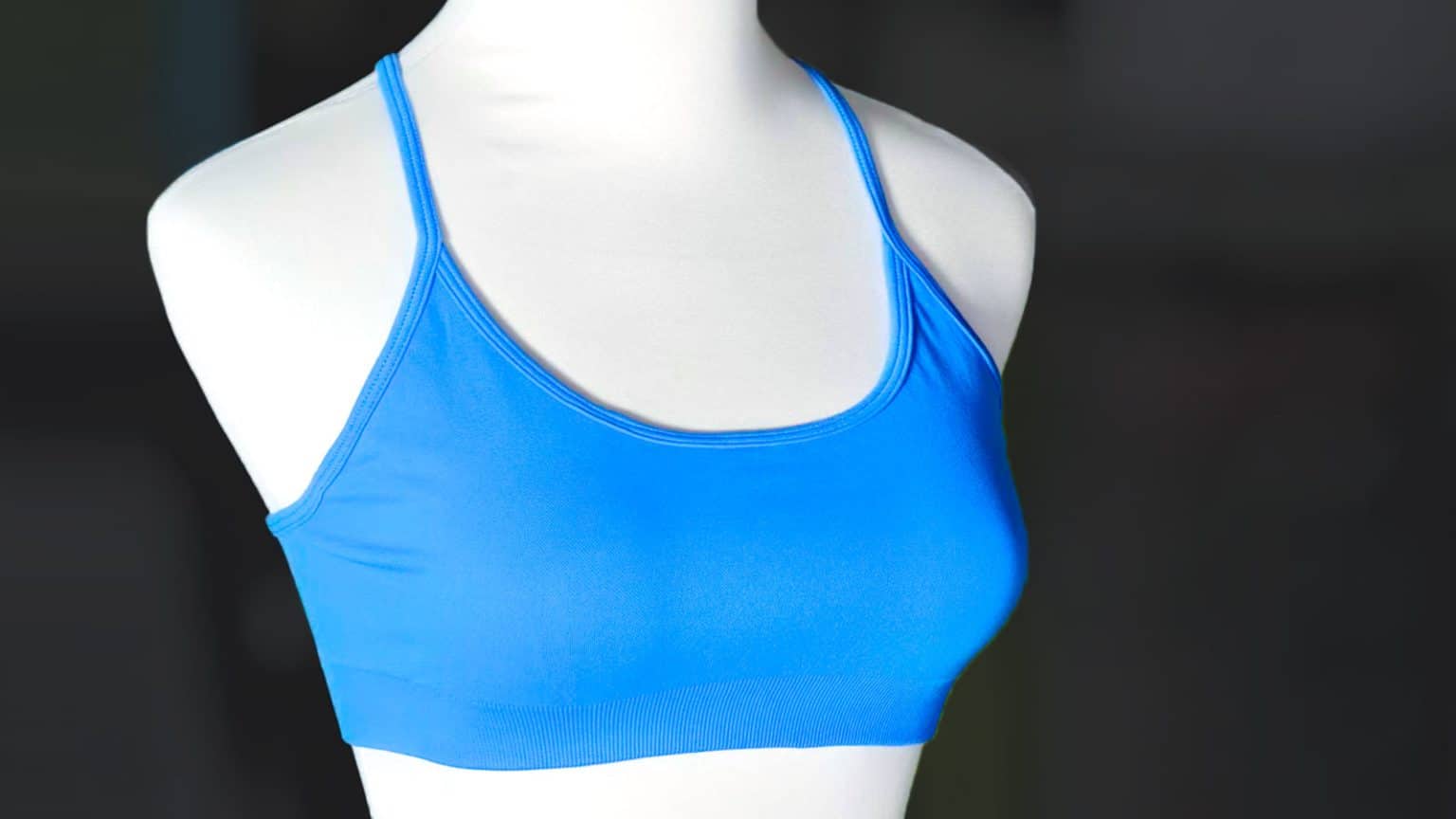
For activewear brand owners, understanding how to pick a sports bra goes far beyond retail preferences. When you are sourcing and manufacturing different types of sports bras, a minor miscalculation in a tech pack can lead to sizing failures, poor fabric recovery, and high return rates.
Whether you are developing a high-impact sports bra for running or a low-impact sports bra for yoga, getting the specifications right is critical. Backed by insights from our own factory—a 12,000㎡ facility with over 180 employees and an annual capacity of 2.5 million pieces—this guide translates consumer fitting needs into professional B2B manufacturing standards.
1. The Ultimate Sports Bra Sizing Guide for Tech Packs
When your customers ask how to measure for a sports bra, the instructions you provide on your website must directly align with your factory’s grading logic. Many brands face a critical pain point: most brands only approve samples in a base size (like size M), overlooking the physical property that stretchy fabrics cannot be scaled linearly. This results in XS sizes being too constrictive and L/XL sizes losing their support.
Standardizing Measurements for Your Customers
To ensure your buyers choose the right sports bra, your brand’s sizing page should provide clear, standardized instructions.
- Measure chest circumference: Use a tape measure to measure the fullest part of the chest, accurately circling it.
- Measure lower circumference: Measure around the bottom of the chest to ensure the tape is close to the body but not too tight.
- Compare Size Chart: Refer to the brand’s size chart to find the corresponding bra size.
- Pay attention to the elastic band: The bottom elastic band should closely fit the body, not too tight, and provide adequate bra support.
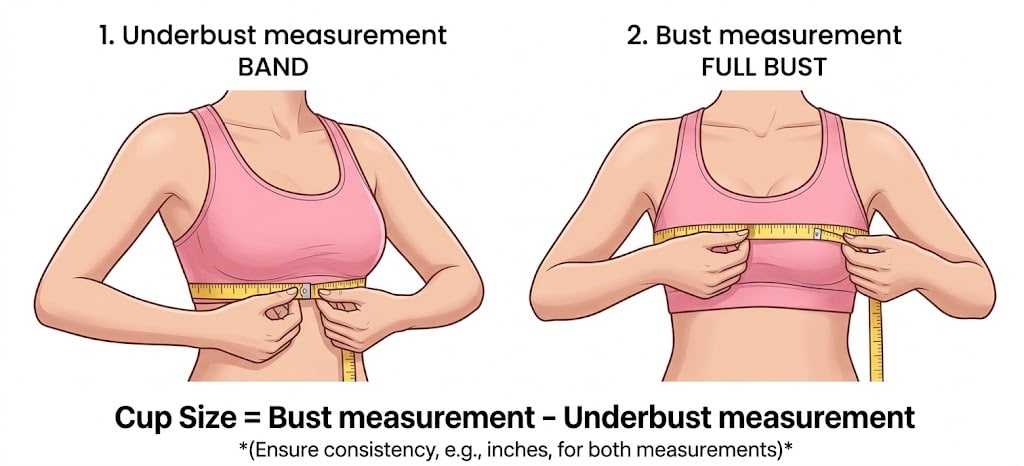
Converting Sports Bra to Bra Size in Production
In the manufacturing phase, translating an everyday bra size to a sports bra size requires precise grading. The industry standard utilizes the cup difference logic:
| Cup Size | Difference (Inches) | Difference (CM) |
| AA | Less than 1″ | < 2.5 cm |
| A | 1″ | 2.5 cm |
| B | 2″ | 5.0 cm |
| C | 3″ | 7.5 cm |
| D | 4″ | 10.0 cm |
| DD (E) | 5″ | 12.5 cm |
| DDD (F) | 6″ | 15.0 cm |
| G | 7″ | 17.5 cm |
The Manufacturer’s Secret: To prevent grading failures, we employ the Three-Size Fit Validation. We never just scale up a medium pattern. By validating the XS, M, and XL proto-samples independently on fit models, we adjust the tension mapping in our Santoni SM8-TOP2V seamless machines to ensure the level of support remains consistent across all sizes.
2. Structural Designs: A Sports Bra Comparison Guide
Before initiating bulk production, brand designers must understand how types of sports bras available impact manufacturing costs and stitching techniques.
Choosing Styles Based on Functionality
To build a high-performing activewear line, it is essential to understand the different sports bra constructions and how they cater to various athletic needs. Different activities require specific support structures (Impact Levels), and cup size often dictates the necessary compression and encapsulation.
Key Sports Bra Constructions:
- Wide-Strap / U-Back (Classic Style): Similar to traditional bra silhouettes but engineered with wider, cushioned straps to distribute weight evenly and reduce shoulder fatigue. Best suited for low-to-medium impact activities like yoga and Pilates.
- Racerback / Strappy-Back (Criss-Cross): Features a cross-back or racerback design that stabilizes the bust and provides excellent back support. This construction allows for maximum range of motion, making it ideal for medium-to-high impact training like running, tennis, and basketball.
- Front-Closure / Front-Zip: Designed with a secure front zipper or hook-and-eye closure for effortless wearability. Highly recommended for larger bust sizes (D+ cups), as it offers superior encapsulation, structure, and high-intensity stability.
- Seamless Pullover (Hardware-Free): A streamlined, pull-over design without hardware (no hooks or zips) for ultimate flexibility and comfort. Perfect for low-impact exercises or everyday athleisure wear.
Tech Pack Tip: When detailing your structural designs and colorways in your tech pack, always utilize direct, industry-standard English color descriptions (e.g., simply state “Black” or “Navy”). Avoid literal translations of decorative marketing names, as standardized naming drastically reduces communication errors on the factory floor.
3. Material Selection: How to Choose Sports Bra for Gym vs. Running
Finding your perfect sports bra fabric means balancing the GSM (Grams per Square Meter), stretch recovery, and your brand’s sustainability goals. A common pitfall is ignoring the post-wash recovery rate, which causes the bra to lose its compression and encapsulation properties over time.
Understanding Impact Levels & Exercise Intensity:
- High-Intensity Exercise: Requires both feet to leave the ground (running, cardio boxing). To achieve maximum supportive sports performance, manufacturers use high GSM fabrics (280-320g) with a recovery rate of ≥90% after 5 washes.
- Moderate-Intensity Exercise: Gym exercises like strength training or Pilates. A medium-support sports bra balances moisture-wicking properties with mid-level compression.
- Low-Intensity Exercise: Gentle movements like yoga. Prioritizes 4-way stretch and naked-feel comfort.
| Support Level & Activity | Size S(32A/B/C, 34A/B) | Size M(34A/B/C, 36A/B/C) | Size L(34D, 36B/C, 38A/B/C) | Size XL(36D, 38C/D, 40B/C) |
| Low-Impact (Yoga, Pilates) | Pullover / U-Back | Pullover / U-Back | Pullover / U-Back | Pullover / Wide-Strap |
| Medium-Impact (Cycling, Strength) | U-Back / Racerback | U-Back / Racerback | Racerback / Strappy | Racerback / Front-Zip |
| High-Impact (Running, HIIT) | Racerback | Racerback / Cross-Back | High-Support Cross-Back | High-Support Front-Zip |
| Max-Impact (Marathon, Agility) | High-Support Cross-Back | High-Support Cross-Back | High-Support Cross-Back | High-Support Front-Zip |
Navigating the GRS Certification Trap: Many emerging brands want eco-friendly fabrics (like GRS-certified RPET or bamboo fiber). However, custom GRS yarn often comes with a massive 1-ton MOQ. At YOU Seamless, because we maintain an inventory of over 100,000 pieces of finished goods and greige fabrics, we can offer custom seamless production with an accessible MOQ of just 450-500 pieces per style, ensuring you meet sustainability standards without crippling your cash flow.
4. Standardized PPS Wear Test Protocol: How Should a Sports Bra Fit?
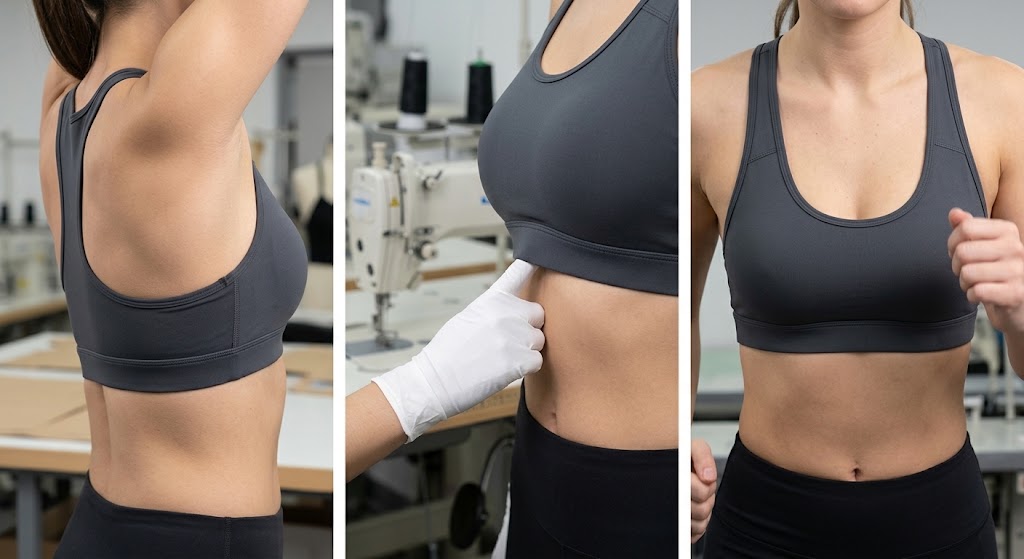
To validate the fit, dynamic stability, and pattern grading accuracy of the Pre-Production Sample (PPS) prior to bulk manufacturing. All fit models must execute the following standardized dynamic movements.
Test 1: The Arm-Raise Mobility Test (Vertical Displacement Check)
- Testing Action: The fit model raises both arms fully above the head, followed by standard overhead stretches and torso twists.
- QC Focus: Underbust band anchoring and strap length tension.
- Standard Pass Criteria (✅): The bottom elastic band must remain firmly anchored to the ribcage without shifting.
- Fail Criteria (❌): The bra rides up the chest.
- Engineering Adjustment (If Failed): Indicates insufficient band tension or incorrect armhole drop grading. Our technicians will directly adjust the digital tension map and needle count on our Santoni machines rather than relying on manual pattern cutting.
Test 2: The One-Finger Tension Test (Band Compression Check)
- Testing Action: The tester inserts one index finger between the underbust elastic band and the ribcage at three points: center front, side, and center back. The finger is then slid along the circumference.
- QC Focus: Elastic modulus, stretch recovery, and breathing room.
- Standard Pass Criteria (✅): The finger can slide smoothly along the band with consistent, moderate resistance. It should feel secure but not restrictive.
- Fail Criteria (❌):
- Too Loose: Finger slides with zero resistance (indicates poor elastic recovery).
- Too Tight: Finger cannot be inserted (indicates excessive compression, restricting breathing during high heart-rate exercises).
- Engineering Adjustment (If Failed): We recalculate the stretch ratio of the selected yarn and adjust the zonal compression programming for that specific size.
Test 3: The Dynamic Impact Test (Bounce & Spillage Check)
- Testing Action: Depending on the designed impact level, the model performs 30 seconds of high knees, jumping jacks, or jogging in place.
- QC Focus: Encapsulation, bounce reduction, and neckline security.
- Standard Pass Criteria (✅): The bust is fully encapsulated within the cups with minimal vertical or lateral bounce. No breast tissue spillage at the neckline or underarm (side boob).
- Fail Criteria (❌): Noticeable spillage, lack of compression, or excessive bounce.
- Engineering Adjustment (If Failed): We increase the neckline height, modify the side wing density, or upgrade to a higher-denier compression yarn.
Every batch leaving our facility passes through a 5-stage, 100% full inspection under the AQL 2.5 standard, guaranteeing that the perfect sports bra fit you approved in the sample room is exactly what arrives in your warehouse.
FAQ: Expert Sports Bra Sizing Advice for Brand Owners
How do sports bra sizes work when adapting for different global markets?
Grading varies significantly between US and Asian fits. Western fits typically require wider armhole drops and deeper cup capacities. Our factory utilizes Zonal Compression Mapping to ensure the support level is customized precisely for your target demographic’s body type.
Why does my high-impact bra lose support after washing?
This usually indicates a failure in yarn recovery or improper heat-setting during manufacturing. We strictly test our Spandex blends to maintain a ≥90% recovery rate, ensuring the correct size sports bra stays true to size wash after wash.
Where can I get professional sports bra sizing help for my new collection?
Partnering with an experienced manufacturer is key. With over a decade of expertise since 2014, YOU Seamless provides comprehensive tech pack support, size grading, and rapid sampling within 8-15 days.
✅ Before You Contact a Sports Bra Manufacturer, Ask Yourself:
- Have I defined my size range and grading logic (S–XL or plus-size)?
- Do I understand the exact GSM and spandex percentage needed for my target level of support?
- Do I know the factory’s MOQ per style and their real production lead time (e.g., 40-45 days for bulk)?
If you need help locking down your specifications, our technical team is ready to assist. Contact us today to get started on your custom activewear line.
