
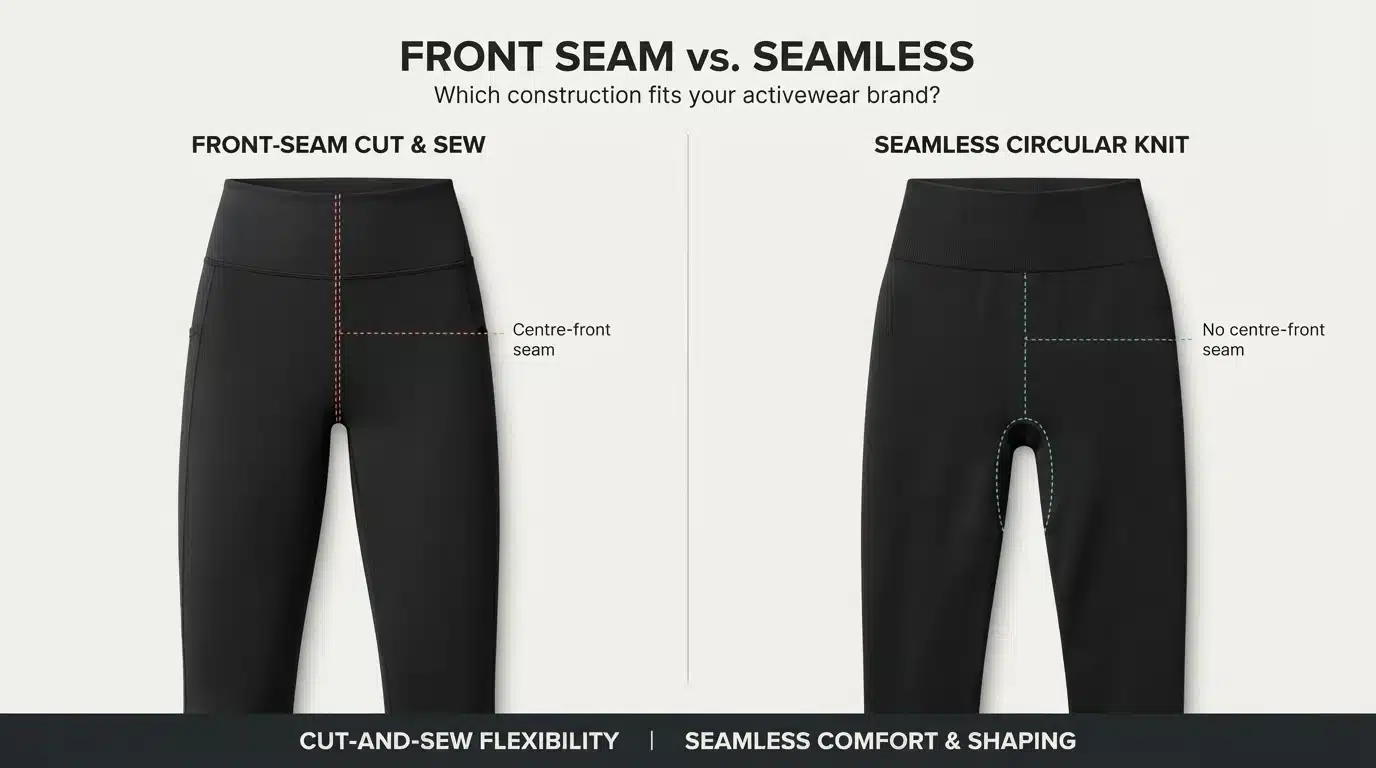
Short answer: In the front seam leggings vs seamless decision, seamless circular knitting usually wins for core leggings. It gives you no front center seam, fewer chafe points, and a consistent fit across a large run. Cut-and-sew wins when your design needs pockets, heavy color-blocking, or multi-panel patterning, or when you need very low order quantities across many styles.
Structural Differences: Front Seam, No-Front-Seam Cut & Sew, and True Seamless
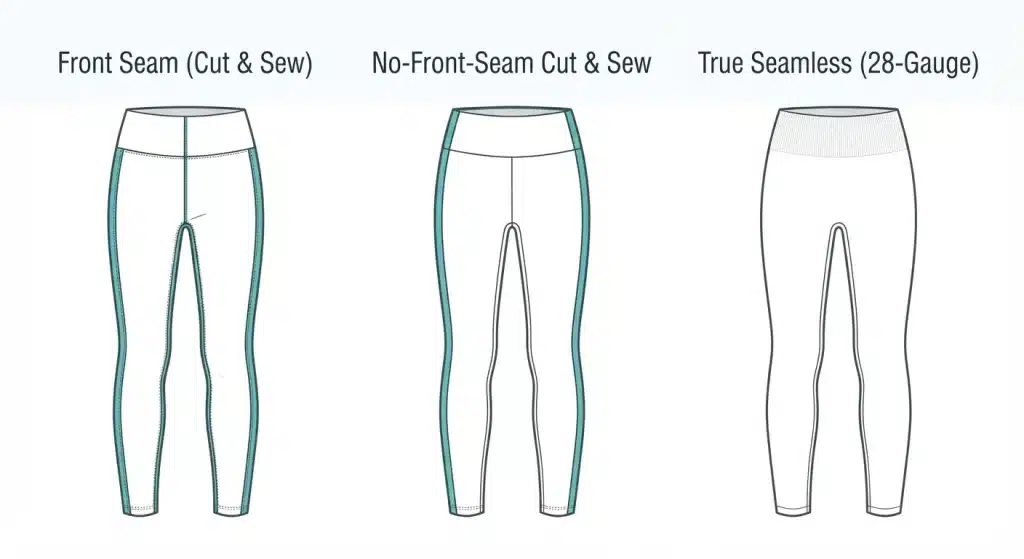
When comparing seamless vs non-seamless leggings, brands actually have three distinct construction options. Each has a different cost, fit, and risk profile.
Traditional Front Seam Leggings
These are cut-and-sew garments. Fabric panels are cut from a roll and joined with flatlock or overlock stitching. A center seam runs from the waistband down through the crotch, plus inseams and outseams.
The method is flexible and well understood by almost every garment factory. The tradeoff is that the center seam sits over the most sensitive area of the body. It also adds bulk during squats, lunges, and sweat-heavy sessions.
No-Front-Seam Cut & Sew
Many brands have moved to “no front seam leggings” made by cut-and-sew methods. The pattern is re-engineered so the front panel is one piece, and the seams move to the back and the sides.
This fixes the main fit complaint without changing the production model. It still carries cut-and-sew costs: fabric waste, panel matching, and more labor. Seam placement and stitch quality still vary from factory to factory.
True Seamless (Circular Knit)
Seamless leggings are knit as a tube on circular machines. YOU Seamless uses Italian circular-knitting technology and 28-gauge fine-gauge construction to engineer tubular bodies, zonal compression, ribbed support zones and knit-in texture. The garment is shaped during knitting rather than cut from flat fabric.
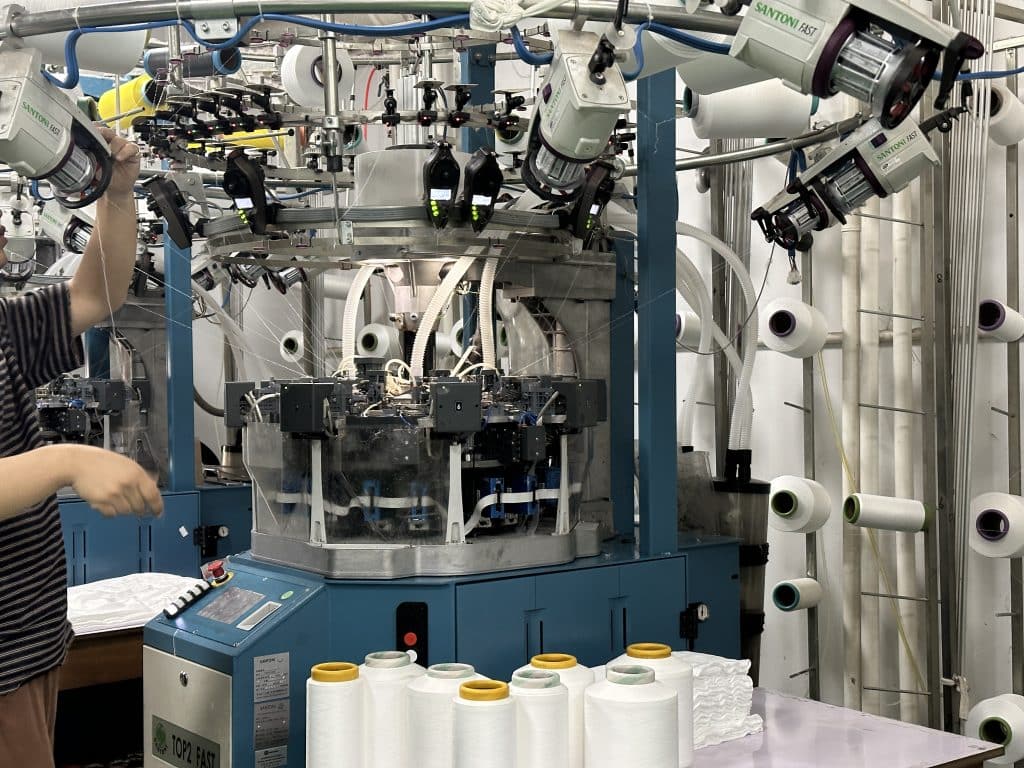
This allows ribbed zones, zonal compression, and jacquard or mesh textures to be built into the knit. The side seams and front center seam are eliminated. Joining and finishing are still needed at the waistband, gusset, and hems, which we handle on Juki and Pegasus industrial equipment.
Solving Buyer & Wearer Pain Points: Camel Toe, Chafing, and Waistband Roll
Across activewear customer reviews and fit feedback, the same complaints come up repeatedly.. For a brand, each one shows up as a return, a bad review, or a lost repeat customer.
Front Seam, Camel Toe, and Friction
Wearers complain that a front center seam bunches and creates an unflattering line. They also report that it chafes during squats and lunges, especially with sweat.
A no-front-seam tubular construction removes the seam line at its source. Fit complaints tied to seam placement are a common reason for returns, so removing that seam lowers that risk. Fit still depends on pattern, fabric, and size grading.
Seam Splitting vs. Gusset Engineering
The usual worry about seamless is that it will rip at the crotch during a deep squat. This concern is fair, because a poorly built gusset is a real failure point.
The fix is engineering. A diamond gusset reinforces the high-stress crotch area where structure matters. High-recovery spandex and correctly set stitching also keep it from failing under repeated stretch. When a seamless pair splits, the cause is usually a weak gusset, low-grade yarn, or poor inspection. The construction method itself is rarely the cause.
Waistband Support and Slippage
Some wearers report that seamless waistbands roll or feel less structured than cut-and-sew versions with a wide, bonded band.
A 28-gauge knit can build denser ribbed zones and tension changes into the waist without adding a harsh seam. These zones are tuned for grip and support. The result depends on the specification: stitch structure, yarn blend, and the tension map should be tested in samples before you commit to bulk.
Are Seamless Leggings More Durable? (Gussets, Yarn Density & Quality Control)
Whether seamless leggings are more durable depends on four engineering factors rather than the label alone. They have fewer stitched joins, so there are fewer places for thread to fail.
- Gusset construction: Reinforcement where stress is highest, such as the diamond gusset.
- Yarn and fiber: High-density knits using Nylon 6 / 6.6 and Spandex blends give stretch recovery and abrasion resistance.
- Knit density: A tighter 28-gauge structure supports squat-proof opacity. It should be checked under stretch, not on a flat table.
- Snag resistance: Knit structure and yarn choice affect snagging. Test sample pieces for your target use, such as gym, studio, or outdoor wear.
Quality control is where durability becomes consistent. YOU Seamless uses a 5-stage, 100% inspection process with an AQL 2.5 standard. You should ask any supplier what their inspection stages are, whether checks cover every piece or only samples, and what defect limit applies.
Side-by-Side Comparison: Front Seam vs. Seamless Leggings
| Factor | Front Seam (Cut & Sew) | Seamless (Circular Knit) |
|---|---|---|
| Construction | Cut panels sewn together | Knit as a tube, shaped on the machine |
| Seams | Front center, inseam, and outseams | No side seams or front center seam; functional joins at waistband, gusset, and hems |
| Comfort / Fit | Depends on pattern; seam bulk and friction possible | Smooth, with fewer friction points and zonal compression |
| Durability | Depends on stitch quality and seam placement | Fewer joins; depends on gusset, yarn, and QC |
| Design Flexibility | Strong for pockets, color-blocking, and multi-panel designs | Strong for knit textures, ribbed and mesh zones, and jacquard; supports hidden waistband pockets for keys or cards, though not suited for external side phone pockets |
| MOQ / Lead Time | Often lower MOQ per style; varies by factory | YOU Seamless: 500–1000 pcs custom; samples 8–15 days; bulk 40–45 days |
| Best Use Cases | Pocket leggings, complex designs, small test runs | Core leggings, bodysuits, and sets in repeatable colorways |
B2B Sourcing Guide: Choosing the Right Model for Your Brand
Use these decision rules before committing to a construction.
- Choose seamless if your core line is leggings, sets, or bras, your styles repeat across seasons, and you can meet the 500–1000 pcs per style total MOQ—which can typically be split across 2–3 colors and standard size runs (roughly 100–200 pcs per color) to keep inventory manageable.
- Choose cut-and-sew or a hybrid if your product depends on external side phone pockets, heavy color-blocking, or multi-panel construction (whereas seamless styles can easily accommodate a hidden waistband pocket for keys or cards). Hybrid sourcing also fits brands that need many styles at very small quantities.
- Test before you commit. YOU Seamless holds 100,000+ ready-to-ship blank units with a 1 pc MOQ for logo printing, labeling, or packaging tests where applicable. This lets you check the market before a custom run.
- Plan your calendar. Samples take 8–15 days and bulk production takes 40–45 days. Build in time for fit approval.
- Check capacity and compliance. Our 12,000㎡ factory has 180+ staff and about 2.5 million pcs of annual capacity. Certifications are OEKO-TEX® Standard 100, GRS (Global Recycled Standard), and Amfori BSCI.
A practical approach is to put your best-selling, repeatable leggings into seamless and keep pocket or panel styles with a cut-and-sew partner.
Frequently Asked Questions (FAQ)
What is the difference between front seam leggings and seamless leggings?
Front seam leggings are cut and sewn, with a center seam running through the front and crotch. Seamless leggings are knit as a tube, with no side seams or front center seam. Some joining is still needed at the waistband, gusset, and hems.
Can you customize compression levels and textures in seamless leggings?
They can be, because they have fewer stitched joins. Real durability depends on gusset reinforcement, yarn quality, knit density, and inspection. A well-made pair of either type will outlast a poorly made one.
Do seamless leggings prevent camel toe?
A no-front-seam construction removes the seam that causes the most visible camel toe complaints. Final fit also depends on pattern, fabric stretch, and sizing, so test samples on fit models.
Can a cut-and-sew legging be made without a front seam?
Yes. A cut-and-sew legging can use a one-piece front panel, revised gusset placement and adjusted rise to remove the centre-front seam. It remains a cut-and-sew garment, so it may still have side seams, inseams and waistband joins.
What is the minimum order for seamless leggings at YOU Seamless?
Custom production starts at 500–1000 pcs per style in total, which can typically be split across 2–3 colors and standard size ranges. If you want to test the market before a custom run, a stock program with 100,000+ blank units is available at a 1 pc MOQ for logo, labeling, and packaging tests where applicable.
Request a Swatch Card, Sample Pack, or Quote
Submit your target style, estimated order quantity, preferred fabric, colour plan and launch date. Our team will assess whether a front-seam cut-and-sew, no-front-seam cut-and-sew, or seamless construction best fits your product line, budget and timeline.
