
If you are a startup searching for small-batch clothing manufacturers, you might have hit a wall. You send an inquiry for seamless leggings, and some factories reply: “Minimum Order Quantity (MOQ): 1,500 pieces per color!”
For emerging brands and established companies testing new markets, these numbers can stall a product launch. You might be accustomed to traditional cut-and-sew factories accommodating 100 or 200 units. Why is seamless knitting fundamentally different?
The answer is not about factory flexibility; it is about mechanical engineering. Seamless manufacturing operates closer to 3D printing than traditional tailoring. Here is the transparent, technical truth behind seamless production processes, and how YOU Seamless has engineered our production lines to offer some of the most competitive MOQs in the global industry.
1. The Machine Calibration & Cylinder Logic
In traditional cut-and-sew manufacturing, a single cutting table handles all sizes. A cutting machine can slice a Size S and a Size XXL from the exact same roll of fabric in one pass.
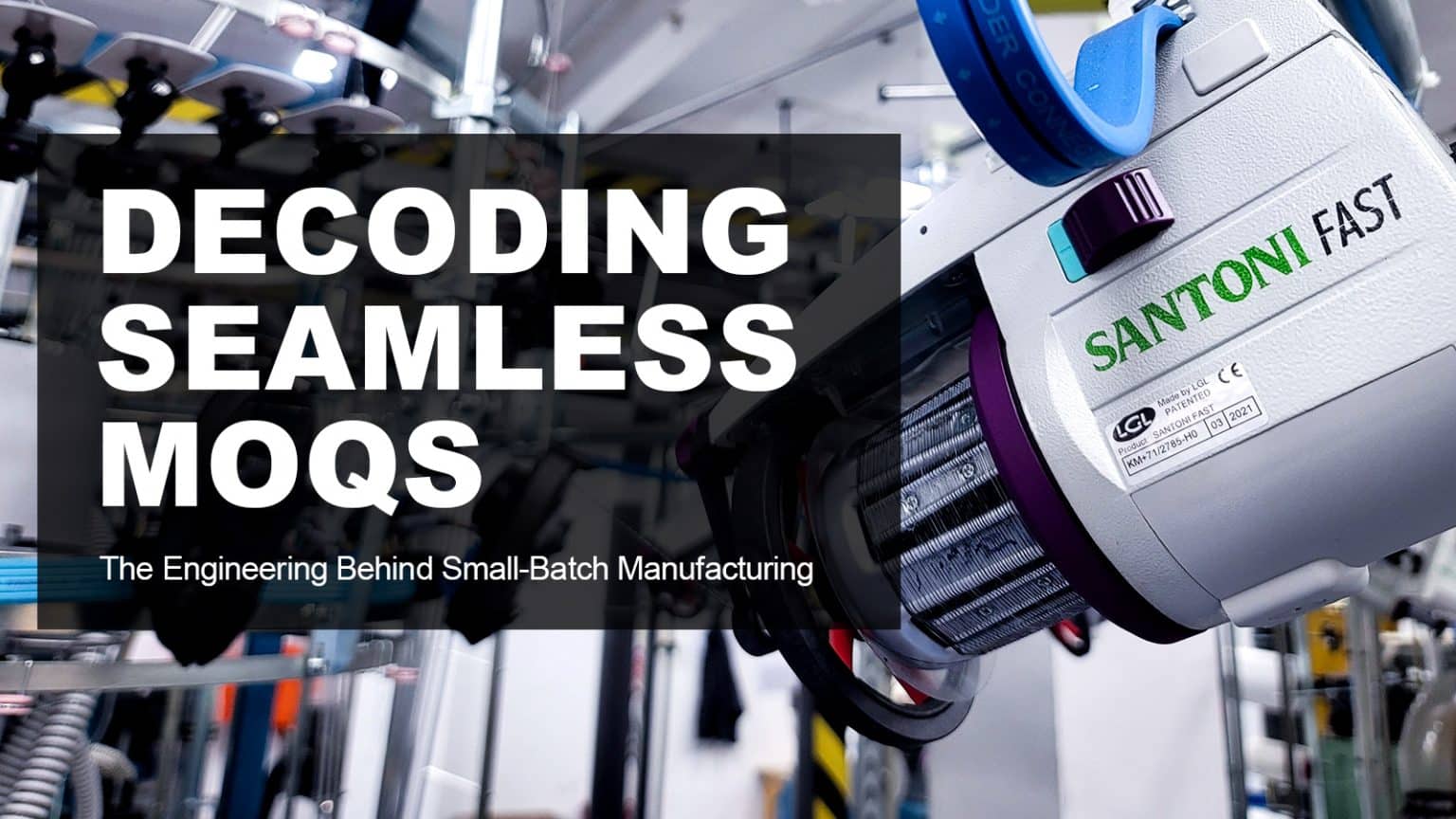
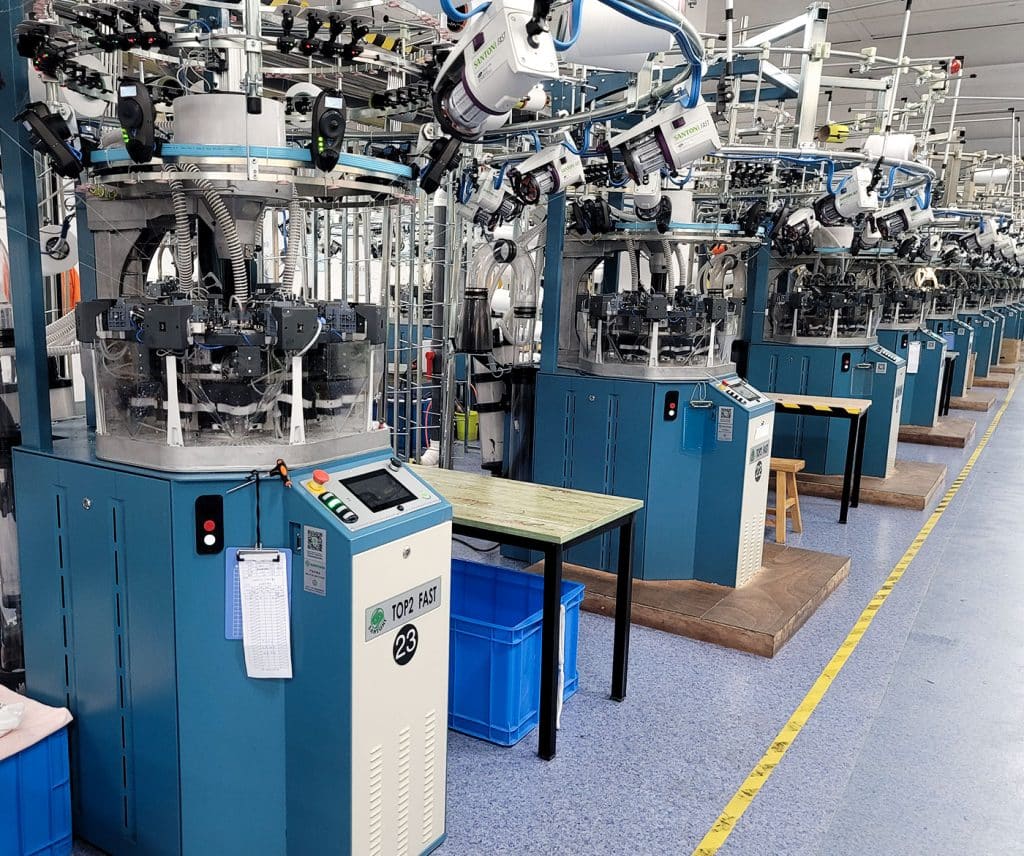
In seamless knitting, size is strictly dictated by the Cylinder Diameter of the circular knitting machine (such as our Santoni arrays).
For example:
- To knit a Size M garment, we might program and calibrate a 14-inch cylinder machine.
- To knit a Size L garment, we must move production entirely to a 15-inch cylinder machine.
If an order of 100 pieces is split across four sizes, we are not setting up one machine—we are fully calibrating four separate machines. For each specific machine (size), we must restart the entire process:
- Import the specific digital program for that cylinder size.
- Thread hundreds of yarn feeders from scratch.
- Calibrate the computer tension individually.
The Math of Loss
Each machine setup naturally produces waste during calibration.
- If you order 1,000 pieces (250 per size), the setup waste is spread out and mathematically negligible.
- If you order 50 pieces (split into sizes), we must spend more time and premium material setting up the 3-4 machines than actually knitting your order.
Constrained by financial or institutional limitations, most factories lack the capability for small runs. They demand high MOQs simply to ensure the machine run-time justifies this complex setup.
2. Dyeing Vat Physics and Liquor Ratios
Seamless garments are often “Garment Dyed” (dyed after the tubular knitting phase) or use specialized yarn dyeing. Industrial dyeing vats work like giant pressure cookers and require a strict minimum load capacity to maintain the correct liquor ratio (water and chemicals to fabric).
Imagine trying to wash a single pair of socks in a massive industrial laundry machine. It does not work; the water-to-clothes ratio is drastically off.
When processing high-performance compositions—such as the industry-standard 92% nylon / 8% spandex blends—maintaining consistent color penetration is a delicate science. If the vat is not full enough, the color becomes uneven and streaky. To dye a 50-piece micro-batch perfectly, factories must fill the tank with “dummy fabrics.” This process forces massive waste in water, dye, and energy, driving up the unit cost significantly.
3. Production Tolerances and Assembly Buffers
While seamless garments lack traditional side seams, finishing them requires highly precise sewing. Operations like attaching a gusset or reinforcing a waistband rely heavily on specialized 4-needle 6-thread flatlock stitching.
In any manufacturing environment, we operate with a “production tolerance.” If a needle breaks during the flatlock stitching process, or a tension error occurs during knitting, that unit is discarded.
- For Large Orders (1,000+ pcs): The industry standard loss rate is about 3%-7%. To guarantee 1,000 perfect units, we intentionally overproduce. Even if 50 pieces fail quality control during knitting, dyeing, or sewing, your final delivery remains unaffected.
- For Small Orders (e.g., 50 pcs): A 5% buffer is only 2.5 pieces.
The Risk: If a needle breaks (which happens in real-world manufacturing), those 2-3 spare pieces are ruined instantly. We might end up with only 47 good units—falling short of your order.
The Solution: For small-batch clothing orders (under 200 pcs), we must significantly increase the safety margin to 10%-15%. This ensures that after weaving, dyeing, cutting, and sewing, you receive the exact quantity you paid for.
4. The YOU Seamless Solution: Engineering for Flexibility
We know that a rigid MOQ of 1,500 is impossible for a startup. YOU Seamless has specifically optimized our factory infrastructure to support both scaling startups and established brands executing agile market tests.
- Stock Yarn Program: We have made significant capital investments to maintain a massive inventory of essential raw materials, including Nylon + Spandex and Polyester yarns in various thicknesses (deniers) and stretch ratios. This robust, ready-to-knit stock gives us a distinct edge over competitors, uniquely positioning us to support your small-batch orders.
- Flexible Production Lines: We dedicate specific Santoni machines exclusively for sampling and small runs, allowing for much quicker changeovers.
- Transparent Pricing: We explain the engineering costs upfront so you can decide the optimal mathematical balance between quantity and unit price.
Our Standard B2B MOQ Structure
For custom seamless items, we offer one of the lowest MOQs in the industry (500-1,000 pieces per design).
For example, based on a premium fabric thickness of 260-400 GSM (as many large global brands use for full-length leggings):
If you want to make a total of 500 pcs of leggings, you can split this run across 3 sizes & 1 color.
This framework provides the exact mathematical balance: it allows us to fill a small dye vat efficiently, run the Santoni cylinders with minimal calibration waste, and provide you with a high-margin, premium product without the massive inventory risk.
Partner with a True Seamless Expert
Don’t let the numbers scare you. Work with a manufacturer that relies on engineering, not guesswork, to understand and scale with startups.
[Contact Our Engineering Team for a Custom Quote & Complete MOQ Specifications]
