
Most guides on how to start a sportswear brand give you the same recycled advice: choose a catchy brand name, design a brand logo, open a Shopify store, and rely on print-on-demand or dropshipping.
In today’s competitive market, that generic playbook is a recipe for rapid failure.
The global activewear market has matured. Modern fitness enthusiasts and athleisure buyers do not just buy marketing; they demand product quality, squat-proof opacity, ergonomic compression, and butter-soft hand feel. Legacy giants like Nike and industry disruptors like Lululemon built empires not on basic graphic tees, but on textile engineering, functional proprietary fits, and specialized manufacturing.
If you want to start an activewear brand that fosters genuine brand loyalty and sustainable margins, you must shift your mindset from an amateur fashion creator to a technical product developer. Below is a comprehensive, factory-level guide to launching a successful sportswear and fitness clothing line—from developing your initial tech pack to scaling bulk production with our own factory floor.
1. Defining Your Brand Identity & Market Position
Before you invest in yarn or sampling, you need absolute clarity on your target audience and brand values.
Amateur Brand Path: Broad audience ➔ Generic gym apparel ➔ High price wars ➔ High returns
Professional Brand Path: Specific technical niche ➔ Ergonomic seamless engineering ➔ Premium positioning ➔ Strong brand loyalty
Finding Your Technical Niche
The modern athleisure and sportswear industry splits into two distinct segments: generic cut-and-sew and circular seamless knitting. While standard cut-and-sew requires cutting flat patterns and stitching bulky side seams, seamless construction creates engineered tubular garments directly from raw yarn.
When conducting your market research, identify which performance niche your fitness brand will dominate:
- High-Impact Training & Gym Apparel: Demands moisture-wicking zones, micro-ventilation, and targeted muscle containment.
- Sculpt & Recovery Loungewear: Demands ultra-soft multi-direction stretch, high-waisted ribbing, and zero chafing.
- Performance Running & Outdoor: Demands gradient compression, abrasion-resistant density, and thermal mapping.
A strong brand identity relies on a clear unique selling proposition (USP). Instead of launching 20 random SKUs of hoodies, t-shirts, and generic jogger bottoms, focus your core activewear line on 2 to 3 hero products—such as the perfect squat-proof leggings and an ergonomic, high-support sports bra.
2. Technical Feasibility: The Core Difference Between Middlemen and Factory Production
One of the costliest traps for an apparel brand startup is sourcing through generic trading companies on B2B directories. Over 70% of listed vendors are middlemen who add a 15% to 25% markup, lack direct technical oversight, and deliver inconsistent bulk lots.
To build a resilient clothing line, you must understand the machinery shaping your garments.
| Technical Parameter | Industry Standard Middleman | Our Own Factory Floor Standard |
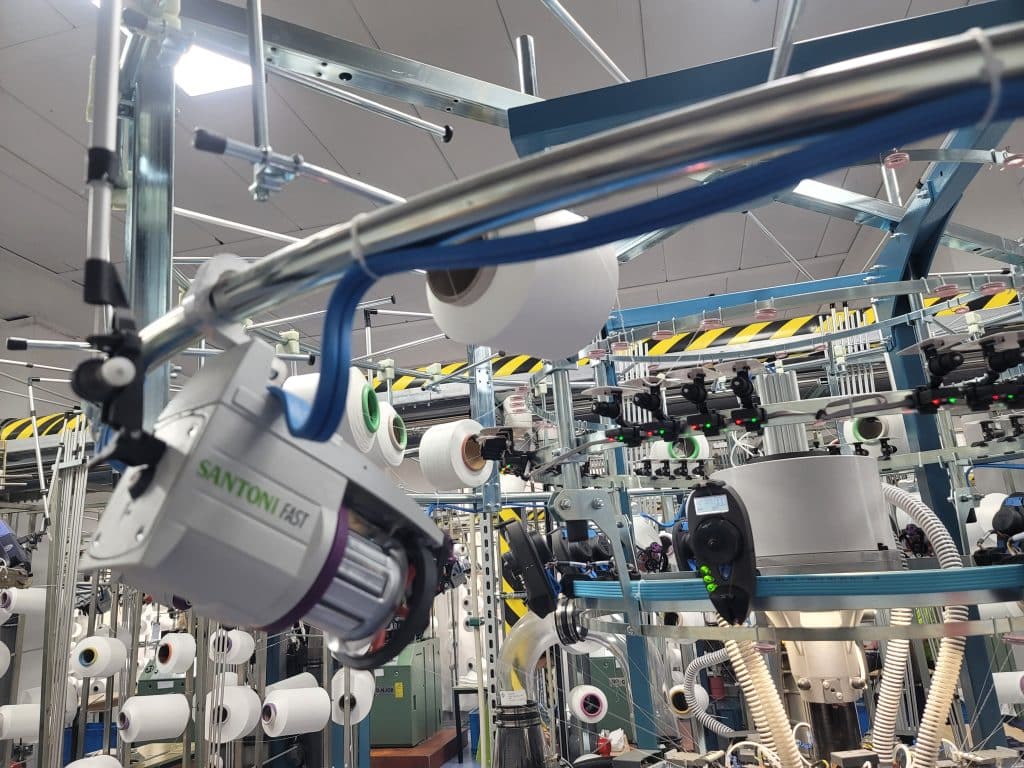
| Knitting Technology | Standard flat knit or older circular models | Genuine Italian Santoni SM8-TOP2V & TOP2 FAST |
| Gauge Precision | 20-24 gauge (coarser hand feel) | 28-gauge fine knit standard |
| Needle Density (13″ Cylinder) | Variable / non-standard | 1,152 needles (+96 needles per +1″ diameter) |
| Seam Construction | Standard overlock | 4-needle 6-thread Flatlock & 3-needle 5-thread Coverstitch |
| Quality Control Standard | Spot-check random inspection | 5-stage 100% full inspection, AQL 2.5 standard |
Santoni 28-Gauge Circular Cylinder (Yarn Feeder)
- Seamless Engineered Tubular Body (Zero Side Seams)
- Breathable Engineered Mesh Zones
- Targeted Waistband Rib Compression
- Precision Post-Knit Finishing (Juki / Pegasus 4-Needle 6-Thread Flatlock)
By engineering functional structures directly on Santoni circular cylinders, seamless garments eliminate irritation, optimize moisture-wicking channels across high-sweat areas, and provide superior tensile durability.
3. Developing Your Tech Pack & Fabric Selection
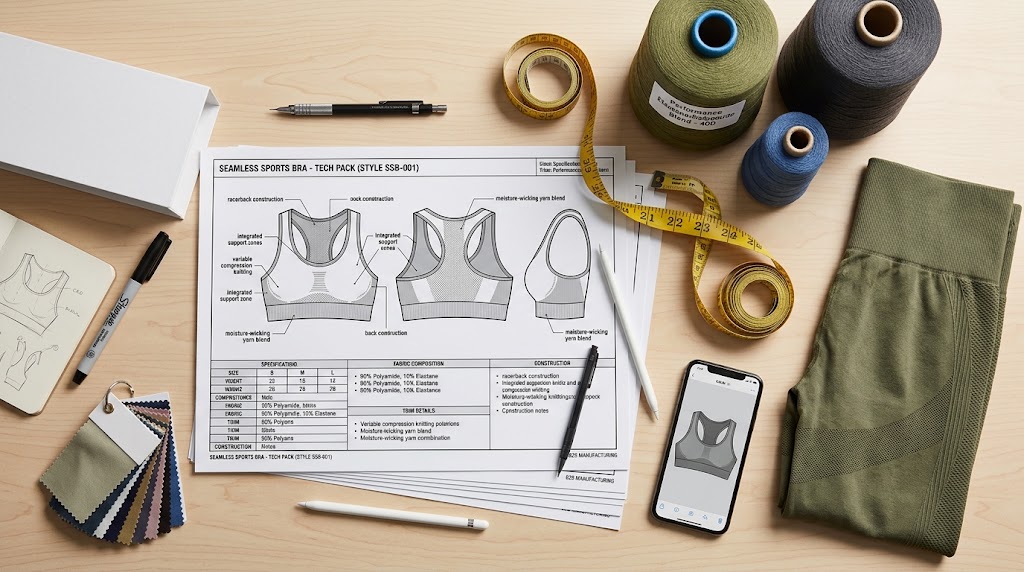
When building your business plan for a fitness clothing business, your tech pack is your legal and technical contract with the production floor.
Choosing the Right Type of Fabric and Yarns
In seamless athletic apparel, fabric is not bought off a roll; it is engineered on the machine by blending specific continuous filament yarns. Current market trends prioritize high-performance sustainable fabrics:
- GRS-Certified Recycled Polyester (RPET): Sourced from post-consumer recycled plastic bottles. Delivers high tensile strength, rapid drying, and full batch-level traceability with genuine Transaction Certificates (TC).
- Elastane / Spandex Blends: High-recovery activewear requires 15% to 25% spandex to deliver true 4-way stretch without permanent bagging at the knees or elbows.
- Technical Functional Blends: Integrating bamboo fibers and breathable polyamides for hypoallergenic skin touch and thermal stability.
- Safety & Compliance: Never work with unverified chemical dye houses. Demand OEKO-TEX® Standard 100 certification and Amfori BSCI workplace compliance to protect your brand equity in North American and European markets.
The Squat-Proof Standard: Density vs. Transparency
A common complaint among customers buying leggings from a new clothing brand is sheer or see-through fabric during deep squats.
- Fabric Density: High-performance seamless leggings should maintain a fabric weight between 180 and 260 GSM (grams per square meter).
- Opacity Testing: In our own factory testing lab, all legging batches undergo a 50% multi-axis stretch evaluation under standardized daylight bulbs. If undergarments or skin tones are visible at 50% elongation, the yarn density program is adjusted before bulk production proceeds.
4. Navigating MOQ, Sampling Timelines, and True Landed Costs
New founders often get stuck between two extremes: paying inflated per-unit costs with print-on-demand services, or being forced into unrealistic minimum order quantities (MOQs) of 2,000 pieces per style.
To balance inventory risk with profitability, a calculated production roadmap is required.
Product Development & Production Timeline:
- Ready-to-Ship Samples: 2–3 Days
- Custom Seamless Prototype: 8–15 Days
- Pre-Production Sample (PPS): Client Sign-Off
- Bulk Production: 40–45 Days
Minimum Order Quantities (MOQs) Demystified
Circular knitting machines require precise yarn spooling, tension balancing, and technical programming. Consequently, ultra-low quantities like 20 pieces per color create high machine setup waste.
- Stock Program for Fast MVP Testing: Start small and test your brand proof-of-concept using our 100,000+ unit finished goods and greige stock reserve with an MOQ starting from just 1 piece.
- Fully Custom OEM Seamless: A sustainable, scalable threshold for custom designs is 500–1000 pieces per style. When scaling to 600 pieces, production can comfortably encompass 2 distinct colorways and 3 graded sizes.
Realistic Sampling Lead Times
While many trading firms require 3 to 4 weeks just to ship an initial draft sample, direct manufacturing significantly accelerates your go-to-market cycle:
- In-stock physical samples: Dispatched in 2–3 days for rapid tactile and fit verification.
- Fully customized structural samples: Completed within 8–15 days.
- Bulk production execution: Completed within 40–45 days following final Pre-Production Sample (PPS) sign-off.
Calculating Your Real Landed Cost
Never build your retail margins solely around Ex-Works (EXW) or Free-on-Board (FOB) quotes. Calculate your complete landed cost structure:
True Landed Cost = FOB Unit Price + Freight per Unit + Import Tariffs/Customs + Clearance Fees + Local Fulfillment
Factoring in a standard 12% to 18% import duty alongside international logistics ensures your target gross margins remain north of 60% when selling direct-to-consumer on your online store.
5. From Online Store Launch to Customer Acquisition
With high-performance products in production, focus your marketing engine on building brand recognition and driving targeted conversions.
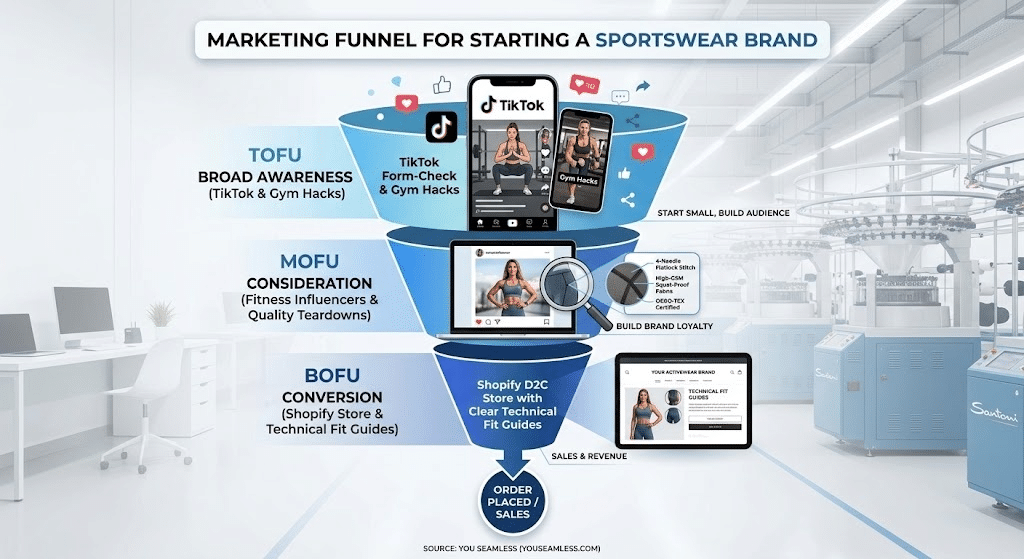
Marketing Funnel:
- Top-of-Funnel: TikTok Form-Check & Gym Hacks
- Mid-of-Funnel: Fitness Influencers & Product Quality Teardowns
- Bottom-of-Funnel: Shopify D2C Store with Clear Technical Fit Guides
Architecting a High-Converting Shopify Store
Your e-commerce platform must communicate engineering, not just aesthetic lifestyle photography. Ensure your product detail pages (PDPs) feature:
- Technical Fabric Badges: Explicitly display your fabric composition (e.g., GRS-certified RPET + Spandex), moisture-wicking capabilities, and 4-way stretch metrics.
- Precise Size & Compression Charts: Detail compression level (Light, Moderate, High) and inseam measurements to minimize return rates.
- Transparency & Craftsmanship Highlights: Emphasize the specialized flatlock seam construction and circular knit integrity.
Growth Engine: Organic Social & Fitness Influencers
Rather than spending tens of thousands on unfocused paid advertisements, partner with micro-tier fitness influencers across TikTok and other social media platforms.
- Product Seeding: Send pre-production prototypes to personal trainers, pilates instructors, and powerlifters.
- Performance Demonstrations: Encourage creators to film real-world durability tests—such as friction resistance tests, high-sweat sessions, and deep squat reviews. Authentic user demonstration drives far higher conversion rates than staged studio imagery.
Frequently Asked Questions (FAQ)
What is the minimum budget required to start a sportswear brand?
While a basic MVP utilizing ready-to-ship blank stock can be launched for $3,000 to $8,000, launching a custom, proprietary apparel brand with custom-knit seamless sets typically requires an initial capital investment of $10,000 to $20,000. This budget covers custom sampling, custom seamless bulk runs (450–500 pieces per style), professional photography, branded trims, and initial marketing launch campaigns.
Can seamless activewear be made via print-on-demand?
No. True seamless activewear is produced on dedicated circular knitting cylinders (such as Santoni machines) that knit the tubular body of the garment directly from continuous yarn spools. Print-on-demand services rely on pre-made, flat-sewn polyester blanks that cannot replicate engineered breathability zones, high-density waistband compression, or authentic seamless construction.
What is the difference between standard overlock stitching and 4-needle 6-thread Flatlock?

Standard overlock stitching leaves a raised, rounded interior seam that creates chafing and pressure marks against the skin during high-intensity workouts. A 4-needle 6-thread Flatlock stitch (executed on precision Juki or Pegasus machinery) joins fabric edges flush together side-by-side with zero overlap, resulting in an exceptionally strong, completely flat, and friction-free seam.
How do I ensure my custom activewear meets international sustainability standards?
Always verify that your manufacturing partner sources certified recycled yarns with traceable GRS (Global Recycled Standard) Transaction Certificates (TC). Additionally, ensure chemical treatments, dyes, and elastic compounds comply with OEKO-TEX® Standard 100 and factory operations are audited under Amfori BSCI.
Build Your Brand with Direct Technical Manufacturing
Launching a distinguished fitness clothing brand requires moving past generic middlemen and aligning with an agile, technically capable manufacturing partner.
At YOU Seamless, our own factory operates across 12,000 square meters with 180+ skilled technicians and an annual capacity of over 2.5 million pieces. Equipped with Italian Santoni circular knitting machines and end-to-end AQL 2.5 quality control, we help emerging and established activewear brands engineer market-defining collections.
Ready to start an activewear brand with high-performance manufacturing?
- Contact Our Engineering Team to discuss your collection concept.
- Request an In-Stock Fabric Swatch & Sample Pack (Dispatched within 2–3 business days).
- Submit your tech pack for an itemized, transparent manufacturing breakdown.
